


Menu
By theme
By theme

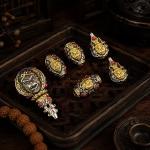
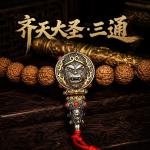
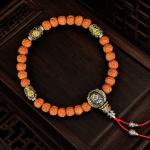
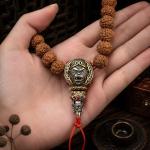
{{ variable.name }} : {{ variable.values[selectedVariantsIndex[variable_index]].name }}
Quantity:
The term back cloud comes from the court necklace system. Qing court necklaces had a guru bead, a back cloud, counters and a drop; the back cloud hung behind the guru bead and down the back, weighting the necklace and decorating it. Bracelets borrowed the structure, and the back cloud became a small ornament hanging at the back. The name sounds esoteric, but it is only a position. Court necklaces were part of an official's formal dress in the Qing, with materials graded by rank, and the rules were detailed. The counters were small strings hanging to either side of the guru bead, the drop at the very bottom, and a set was only correct when complete.
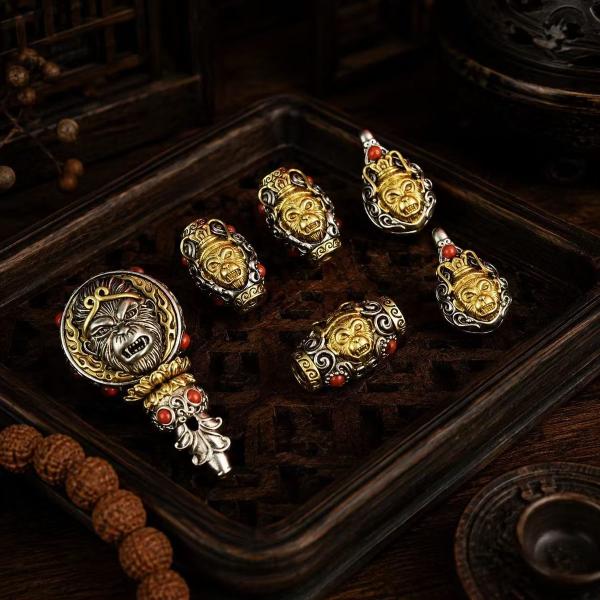
The set pairs the three-hole bead with the back cloud, saving you the trouble of assembling one. The three-hole bead goes above and the back cloud below, and the connecting cord can be set to your own length: shorter sits close to the wrist, longer hangs. How much cord depends on your wrist and on what you wear. The back cloud sits on the back of the wrist, hanging clear of the desk, so it does not get in the way of writing. Elastic or non-elastic depends on whether you take the piece off often.
Sun Wukong is the title from Journey to the West. He styles himself Great Sage Equalling Heaven, level with the sky, and the title is the most arrogant stroke in the whole book. The image is fixed: a purple-gold crown, chain-mail armour, the golden-hooped staff in hand, an air of refusing to be governed. New Year prints, shadow puppets and opera masks all use the same set. The staff has gold bands at both ends and dark iron between; on small pieces usually only the plain rod is kept, with the bands dropped. Sun Wukong's image settled in the Ming; in earlier pilgrimage pictures he is still simply a monkey, without the armour. Suit yourself.
A subject like this carries a bit of play in it, and it goes with plain beads or wooden ones; there is no need to dress it up too seriously. The copper surface is densely worked, and the crown and armour only resolve close up; from a distance it is a single silhouette. If you want to be particular, straighten the direction of the staff section, which hangs more pleasingly that way. If the crown's plume feathers are made, they stand above the head, so be careful not to crush them when putting the piece away. On an all-dark string the brightness of the copper can be glaring, and an antiqued version may suit better.
A set has several parts, and they are easily lost when taken off. Keep them in a small box of their own rather than mixed in with other strings. White copper marks against hard objects, and the staff section is the thinnest part; do not let it bend, because a bend is hard to take out and forcing it back tends to crack. If the hole in the three-hole bead is too small, change to a thinner cord rather than reaming it out, which is liable to split it.