


Menu
By theme
By theme


{{ variable.name }} : {{ variable.values[selectedVariantsIndex[variable_index]].name }}
Quantity:
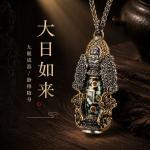
Vairocana is the root Buddha of the tantric system, in Sanskrit Vairocana, meaning light shining everywhere. In the Huayan and tantric systems he stands for the dharma body, the aspect in which principle and wisdom are not two. The mandalas of both the vajra realm and the womb realm are centred on him. In Chinese monasteries the Vairocana hall is often set at the rear of the whole complex. The 'great sun' in his Chinese name is a metaphor — sunlight shining everywhere, reaching every place — and does not mean the sun itself. In the womb realm his seed syllable is the letter A, which is what is cut on many implements.
The nine-eye dzi is one class of pattern among Tibetan beads. Dzi is the Tibetan name, and they are regarded as sacred objects that fell from the sky, with patterns including eyes, tiger teeth, lotus, treasure vase and line beads, and eye counts from one to twelve. Nine eyes is a common one, with nine round eyes set in three rows. Its origins are much debated and not settled. Apart from eyes, the tiger-tooth pattern is the most common, a row of pointed teeth carrying the sense of subjugation. Dzi beads are mostly long tubes or ovals, with the eye pattern running along the body.
The eyes are round, the borders must close, and the pupil must sit true. The nine-eye arrangement depends on symmetry: a middle row of three and three above and three below, and one eye out of place throws off the whole bead. That is the most basic way to look at a dzi pattern — symmetry first, then whether the lines are of even weight. The central eye of the nine is the largest and the other eight slightly smaller, and that proportion is where authenticity is read. Line weight should be even; lines that swell and thin were usually painted and then cut. There is no skipping this step.
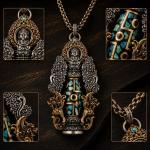
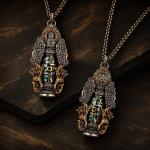
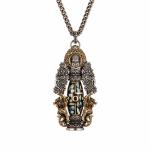
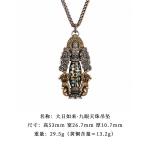
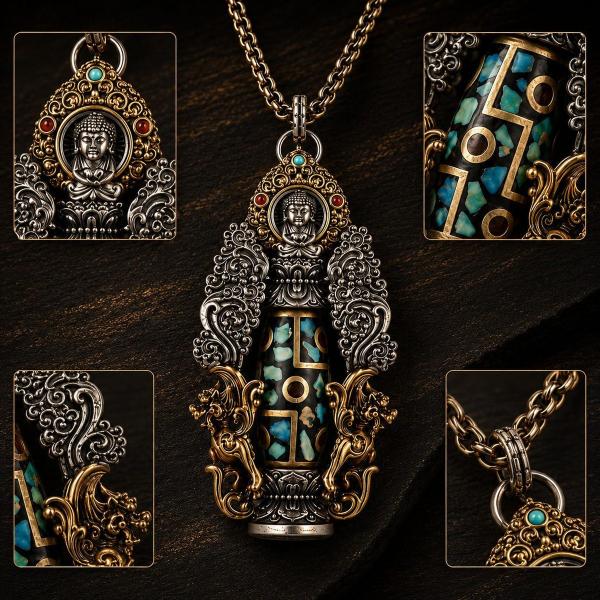
This piece puts Vairocana's image and the nine-eye pattern together, a Buddha on one face and a bead on the other. Each element has its own reading, and combined on one piece the wearer can take whichever layer they like. The cord should not be busy; plain is best, and lets the front speak for itself. The Buddha face usually has snail-shell curls and the meditation gesture, seated on a lotus throne, a steady composition. Against a dark cord the pale copper holds the front up nicely.
White copper has a pale ground, and the nine-eye borders read more clearly in the metal than in a photograph. Against dark clothing the outline of the pendant stands out most; against pale clothing you have to be closer to see the pattern. Chain and cord are supplied separately; choose a fine one, so that it does not overpower the figure on the front. If the pendant turning over bothers you, a short stop knot at the clasp will hold it. If you want both faces to show, it can be worn as a double-sided pendant, with the cord through the top hole, so that it can be turned without taking it off. Change the cord when it wears; do not wait for it to break.