


Menu
By theme
By theme

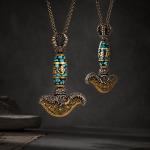
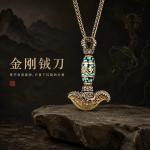
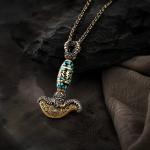

{{ variable.name }} : {{ variable.values[selectedVariantsIndex[variable_index]].name }}
Quantity:
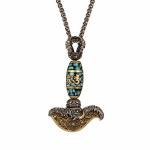
The vajra knife has the sharpest shape of any implement in the Tibetan ritual kit. A curved blade with the edge turning inward, the end of the handle usually finished as a vajra or a hook, so that the whole reads like a hooked knife. It usually appears paired with a kapala bowl, knife in one hand and bowl in the other. The pair is most concentrated in the union figures of thangkas, where it is almost standard. Its shape differs from a Chinese sabre: the curve is more abrupt. The vajra knife is rare in Chinese temples, appearing mostly in Tibetan images and thangkas.
Explanations of the pair differ slightly between traditions. A common one runs: the knife stands for cutting off and the bowl for emptiness; the knife cuts through self-clinging, the bowl holds amrita. Others say the knife is method and the bowl the result, which differs in words but points the same way, putting cutting and holding in one place. The kapala is a skull vessel, with a liturgy of its own in Tibetan practice, and not an ordinary object. In union figures the knife and bowl stand for method and primordial wisdom, and neither is complete without the other.
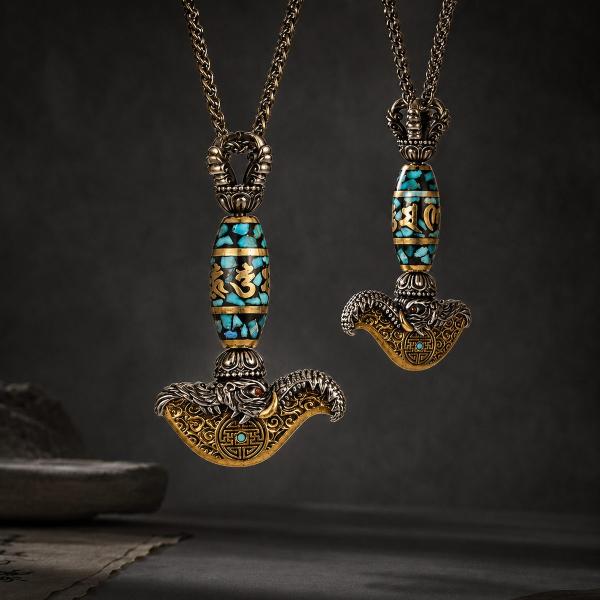
Made as a pendant on its own, the sense of sharpness is the point of it. The curve of the blade should run smoothly from handle to tip in one movement, with no break in it. Reflections on a curved copper face shift with the angle, and at a certain point a bright line runs along the edge; if that line breaks, the curve is wrong. The inner side of the curved blade is ground, and the surface should be continuous; a break in it gives the work away. The proportion of handle to blade is about one to two, short handle and long blade; anyone used to knives will find that odd.
The blade is pointed, so mind which way it faces and what it knocks against. Worn against the body it catches on knitwear, so a bag charm or a car charm is easier. Copper fears sweat; wipe it after wearing in summer. Hanging from a bag, keep it out of the same compartment as keys. As a necklace, the weight of the pendant sits high, so the cord should be a little shorter to stop it turning. A cord frays with wear; change it every six months.
This subject is a cool one, and it suits plain or dark clothes; against a print it looks muddled. Some people keep it with a vajra, one to cut and one to protect, and the pair looks orderly set out together. As a gift, think twice: not everyone will accept the shape. It is a fierce shape, so in a house with children keep it high up rather than on a low cabinet. As an ornament it will not stand on its own and needs a small stand.