


Menu
By theme
By theme


{{ variable.name }} : {{ variable.values[selectedVariantsIndex[variable_index]].name }}
Quantity:
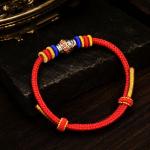
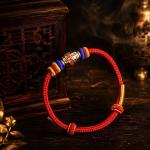
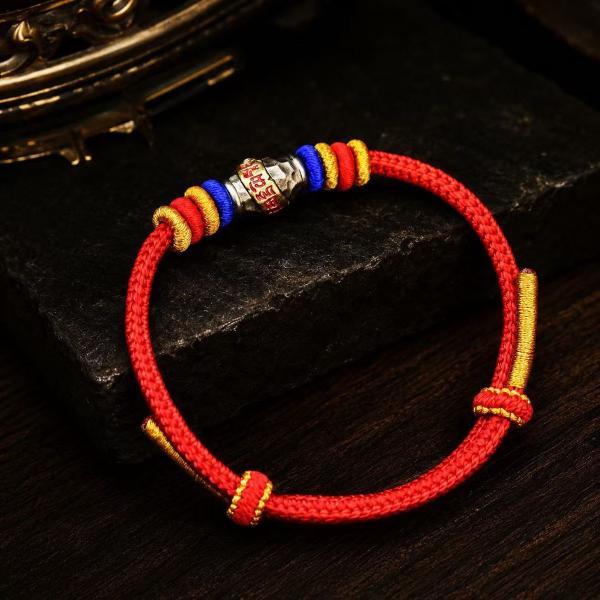
In a zodiac year, or simply out in the world, plenty of people replace the red cord once a year. This one is braided, the cord itself textured, with the Yellow Jambhala mantra worked into a section at the centre. The red is true red, neither orange-leaning nor dull, and it stands out on the wrist. The braid runs one way the whole way round with no unnecessary joins, and the inside is clean too, with no loose end sticking up. The knot is drawn into the tail and tucked inside the loop, so it does not dig in against the skin.
Yellow Jambhala is the first of the five Jambhalas in Tibetan Buddhism: golden in colour, a wish-fulfilling jewel in his right hand, a mongoose in his left, one leg slightly extended, seated on a lotus. The mantra is short and easy to recite. Tibetan devotees use it mostly to ask for a smooth living, not for wealth dropped out of the sky. Red cord has an older use in Han China: red in a zodiac year, red when travelling, meaning simply that bad things are kept outside. The two traditions sit on one cord without conflict; both are ordinary people finding a bit of reassurance. The mantra section sits towards the inside, seen only when you look down. It was never meant for other people's eyes.
Braided cord wears better than a single strand and does not come apart easily; over time it settles into the shape of your wrist. The drawback is water, so take it off for washing hands and showering. Once the braid is soaked with sweat and soap it hardens and fades after a few dryings, and the red drifts towards pink. In summer, rinse it in clean water at night and dry it in the shade, never in the sun, which takes a layer of colour off each time. It feels a little tight at first. Braid gives, and after a week it lies flat, so do not work it to the loosest setting to begin with.
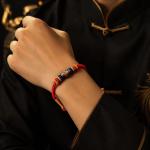
The fit is set by the knots. Worn, it should not spin round the wrist or leave a mark, and one finger should slip underneath. With a shirt, a little showing beyond the cuff is quieter than a string of beads, and it does not fight a watch for space. Red suits most skin tones and most ages: on a slim wrist it does not look empty, on a broad one it does not look mean.
For an older relative, or a friend just starting out in business, it is a safe choice. It is not expensive; what it has is a clear meaning. The red cord protects, the Jambhala is asked. Both are out in the open, nothing to guess at. When the cord wears out, replace it. The meaning does not need replacing.