


Menu
By theme
By theme

{{ variable.name }} : {{ variable.values[selectedVariantsIndex[variable_index]].name }}
Quantity:
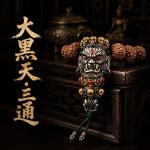
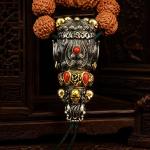
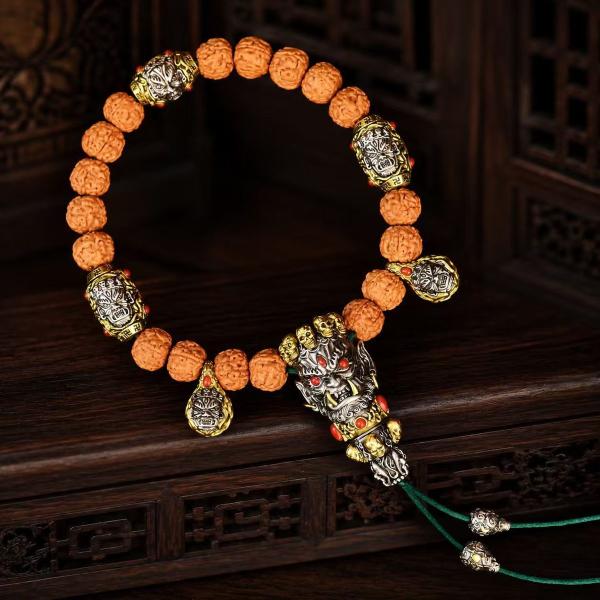
Households keep a deity in the kitchen too, and in Han temples that is not unusual; the one installed there is him. Mahakala has a wrathful face: three eyes, brow ridge pressed low, a crown of five skulls, a curved knife raised in the right hand and a skull cup held in the left. Cast in white copper, a face like this is mostly shadow and very little light. On a table, from across the room, it bears down on you a little; only up close do you see that the teeth are set out one by one. Each of the five skulls in the crown has its own expression. Some grin; some are just two eye sockets.
He is one of the principal protectors in Tibetan Buddhism, and his Chinese name, Da Hei Tian, is a transliteration of the Sanskrit. In Han temples he often keeps watch in the kitchen, in charge of the monks' food, and in folk belief he guards the granary. Carried to Japan he became one of the Seven Lucky Gods, hammer and sack in hand, face grown round, nothing at all like the Tibetan wrathful form. One deity, changing all the way along the road: a common thing in the transmission of images. In thangkas he is usually painted on the outer side of the shrine, more often standing than seated. Recognise him by the implements rather than the face; those two change least.
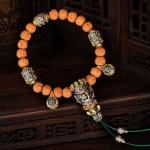
This is a charm set, with Mahakala as the main piece and smaller pieces to match. The white copper is antiqued, the shadows deep, which suits dark strings best: ebony, coconut shell, dark agate all sit steady with it. Anyone devoted to plain strings may find it heavy; anyone who likes presence will find it exactly right, since it is the first thing the eye lands on. It holds its own against silver as well. Copper's warmth and silver's cool sit together and, curiously, stay clearly separate.
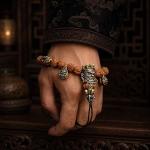
When stringing, set the main piece as the first bead below the guru bead; that is where the visual weight belongs, and the rest of the beads follow on. Put a thin disc between the copper and any other material. Hard against hard grinds a mark into the softer of the two, and with agate the copper is not what suffers. The base of the main piece should sit tight against the guru bead. Hanging free it will swing, and swinging loosens the hole.
Wrapped separately when not worn: copper has many edges, and mixed in with other jewellery it will scratch and be scratched. The subject is on the fierce side. Fine to wear yourself, but choose carefully when giving it, and make sure the person knows this is a protector and not an ornament. Copper needs no oil. Oil collects dust, and the more you apply the dirtier it gets.