


Menu
By theme
By theme




{{ variable.name }} : {{ variable.values[selectedVariantsIndex[variable_index]].name }}
Quantity:
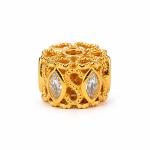
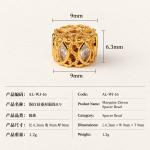
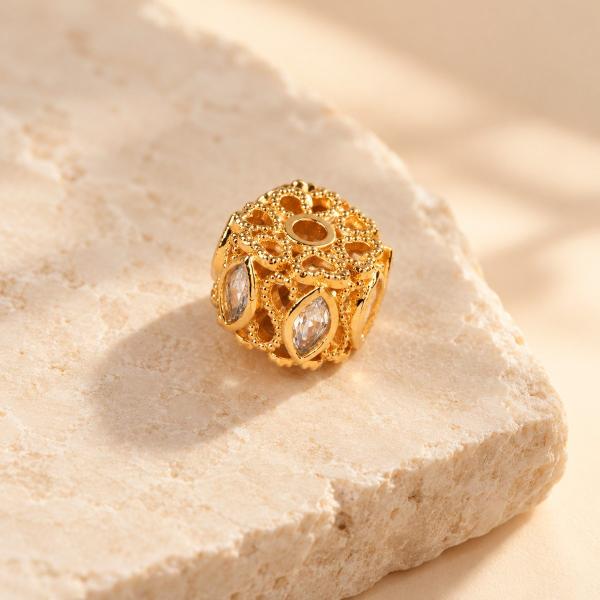
With openwork, look at the border first. This is a small diamond frame with the middle cut away; the frame runs along the four sides and folds back at each corner, white zircon is set into the frame line, and held to the light the middle shows straight through, leaving copper as nothing more than a rim. The width of the frame is even and the joins at the four corners are cleanly finished, with no burr left behind. The piece is flat overall, so it takes up no room on the cord. The hole is chamfered at both ends, and the cord is not cut where it turns.
Openwork is a labour-heavy way to make a metal bead. A solid blank is cast first, then the middle is cut away pass by pass, and the edges are fettled afterwards; fettle them thin and the frame distorts, leave them thick and the piece looks clumsy. What remains has to carry the cord and hold the stones, and both demands have to be met at once. An openwork piece is usually lighter than a solid one of the same size, so it does not drag a long string downwards, which is a real saving. After cutting, one or two places on the frame will inevitably be a little thin; you can see it against the light, and it is not a fault.
White zircon is a cool colour, and set against warm yellow brass it makes a contrast rather than a blend. That contrast works well on a small piece, because small means it does not become noisy. Between dark wood beads the white point jumps out; between pale bodhi it goes quiet instead. If the string already has a large silver piece on it, put this one further back and do not let the two compete. The zircon is cut with round facets, so its fire is scattered rather than piercing, which suits a position nearer the middle.
It works as a spacer, and equally on either side of the guru bead as a visual pause. The open middle lets light through, and on a dark cord you can see the cord passing behind it, a detail some people like and others find restless. A hollow structure dislikes pressure, so do not store it under anything heavy; once the frame distorts it is neither square nor round, and the eye catches it immediately. Clean with a dry cloth rather than soaking it, since water that gets into the seams is slow to dry. There is a short solid section on each side of the hole where the cord turns, so it never presses directly on the frame. Set straight, the diamond shows four equal sides; seen at an angle it looks narrower than it is. Over time a thin film of oxidation warms the frame, and it is not unattractive.