


Menu
By theme
By theme



{{ variable.name }} : {{ variable.values[selectedVariantsIndex[variable_index]].name }}
Quantity:
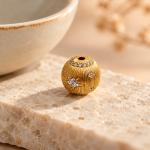
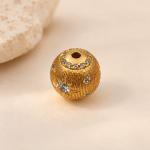
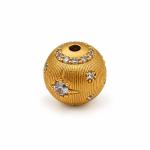
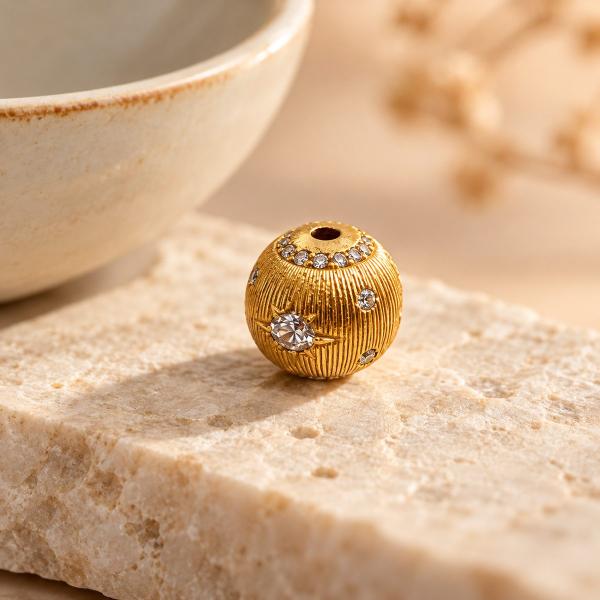
There is a kind of surface that does not throw back your reflection, only a soft sheen. This round bead has it: brushed all over, fine lines circling the sphere, and a waist line around the middle set with a band of small stones. Matte sits next to bright, and under light the two faces separate. The lines are ground in one direction rather than at random, so as the bead turns a band of light travels across it. In summer a brushed surface feels cooler than a polished one and does not cling to the skin.
Brushing is directional grinding with a wheel or an abrasive belt. The marks have to be even and the pressure steady; one deep pass and the piece is spoiled. A brushed face does not take light the way polished metal does. It gives back a soft, broad sheen instead of a reflection you could recognise yourself in. This treatment is not traditional on copper; it came across from modern hardware. On a small piece it works well enough, while over a large area it would look cold and mechanical.
The band of stones is the single bright point on the bead. The stones are not large, but set continuously they make one bright line as the bead turns. The brushed surface holds back the light around them, which is what allows that line to show; polish the whole bead and the stones would disappear. The waist line sits a little above centre rather than exactly in the middle, so the bead's weight seems to settle low instead of floating.
In proportion it is a middle-sized piece: between large main beads it will not be swallowed, and in a string of small beads it does not look out of place. If you want two on one string, leave at least three plain beads between them, otherwise the two highlights sit side by side and neither stands out. For someone who rolls a string vigorously, brushed metal outlasts polished, because scratches blend into the grain and hardly show. If a stone in the band works loose, there will be a faint rattle as it turns; take the bead off and set it aside before the stone drops out and is lost.
Use it as an accent, between two plain beads or at the side of a string. A round bead has no orientation and looks the same whichever way it turns, which makes it easier to place than a piece with a defined front and back. Brushed surfaces hold fingerprints, especially when the hands are oily. Wipe along the grain; wiping across scrambles the marks and leaves what look like scratches. For dust in the stone settings, use a soft brush rather than a needle.