


Menu
By theme
By theme

{{ variable.name }} : {{ variable.values[selectedVariantsIndex[variable_index]].name }}
Quantity:
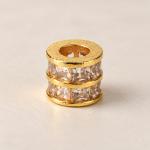
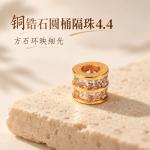
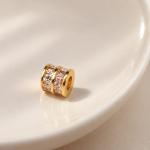
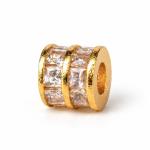
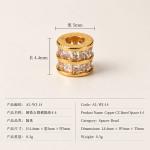
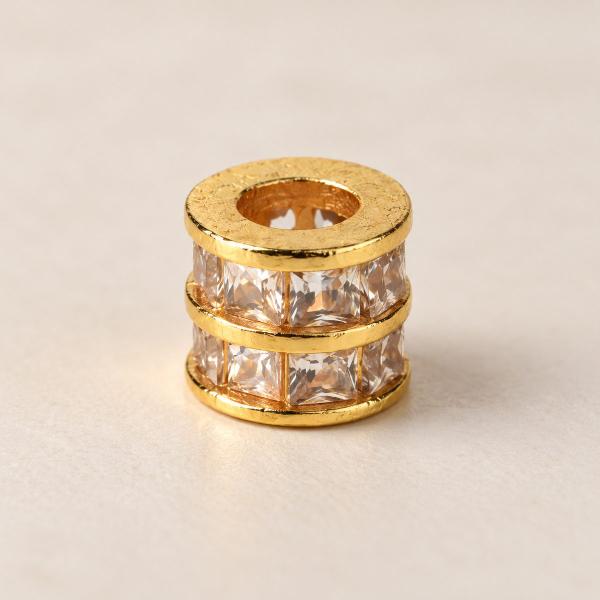
Two large beads sitting directly against each other want this between them. It is a barrel, straight-sided, flat at top and bottom, with a groove turned around the middle and a ring of zircon set into the groove. The copper ground is on the dark side and the two bands either side of the groove are polished back, so bright, dark and bright follow one another across it and read clearly. The hole runs straight through the centre and narrows slightly at the mouth, so the cord does not shift from side to side. The body is low and looks solid, not tall and upright like a tube bead.
Among spacers, a barrel has some bulk. It is thicker than a thin disc and shorter than a main bead, and its purpose is to open a span, to leave the two large beads some room to breathe. A disc solves grinding; a barrel solves crowding. Beads packed too closely look stifled, and a barrel dropped between them lets the eye relax. With only a thin disc between two big beads the gap is so narrow that you can barely get a hand in to string it.
The ring of zircon in the groove is the point of the piece. The groove is cut a little deeper than the stones, so once they are seated their tables sit almost flush with the copper: no abrasion on the cord, and little chance of catching on cloth. As it turns it gives a broken line of light, because copper dividers remain between the stones. That uses fewer stones than a full pavé setting and wears better as well, with the copper colour holding the intervals. The stones are round, the edge of the groove presses on their rims, and the whole reads as a fine circle.
It belongs in the middle of a long string, or where two different materials meet, doing the work of transition. Dark wood is the steadiest partner; against pale beads the copper looks heavy. One on a string is enough, since two will disturb the rhythm. Below the guru bead is a good position too, because that spot wants a little weight anyway. Copper holds its own against dark wood, and it can pull pale bodhi back from looking weightless.
Zircon chips and copper dislikes sweat. Wipe it after wearing in summer, and take the grime out of the groove with a soft brush rather than a needle. Store it separately when it is off: the flat ends chip most easily, and a chip on the edge is visible at once. If the mouth of the hole polishes bright, the cord has been sliding through it a great deal, and it is time to restring.