


Menu
By theme
By theme

{{ variable.name }} : {{ variable.values[selectedVariantsIndex[variable_index]].name }}
Quantity:
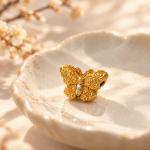
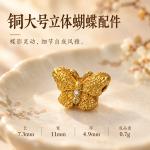
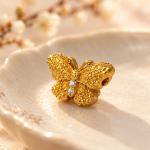
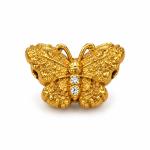
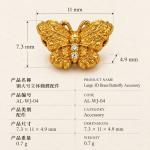
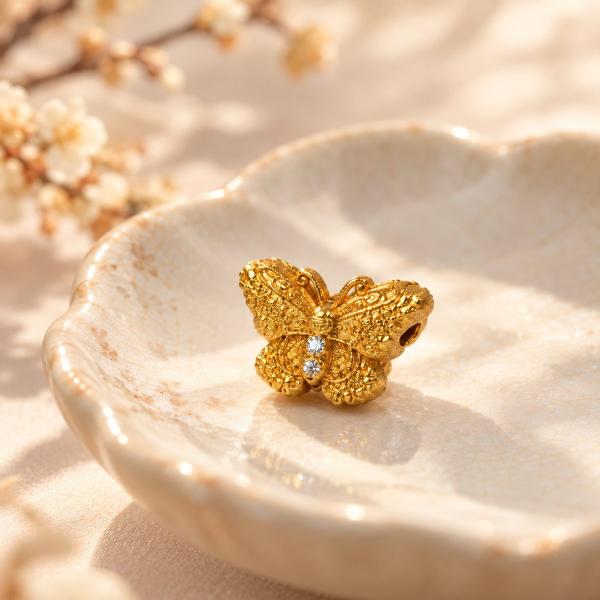
The wings stand up; this is not a flattened plaque. The butterfly has four wings, front and back, lifted upwards, and its antennae are two fine copper wires bent into a curve. The surface is gold plated, a fine line pressed around the edge of each wing, the veins drawn out in shallow engraving. Along the wing edge runs a row of very fine teeth, imitating the layering of scales, which disappears at any distance. The back is flat, with a hole through the middle so the cord passes underneath the body and the wings stand clear.
Butterflies appear very early in old patterns, on clothing, lacquer and bronze mirrors. They are often paired with flowers, a pairing that speaks of spring, and often with a cat, since the words for cat and butterfly together sound like the word for old age, which is why the pair was used to wish an elderly person long life. One shape, a different companion, and two entirely different messages: a common device in traditional pattern. The eyespots on a butterfly's wings exist in nature to startle predators; in pattern they survive as decoration and usually carry no further meaning.
Three-dimensional work is harder than flat work. The wings have to be thin to stay light, so the piece does not drag when worn, and thin metal distorts, so a thickened root is left where wing meets body. Plating shows its quality most on an undulating surface like this: the recesses are hard to coat and the peaks are easy to overcoat. A well-made piece is even on the reverse side as well, which is where careless work shows.
It works as the drop on a charm, or hung below a back ornament. Anything three-dimensional will catch on clothing, so keep knitwear, lace and tassels away from it. On a bag it is very much at home: the wings tremble slightly as you walk, which is the spring of the copper sheet and not a sign of looseness. The angle of the wings is fixed in the casting and cannot be adjusted, so it looks right from one direction only. Worn at the neck, it needs enough length; pressed against the collarbone you lose the butterfly's profile altogether.
The wings are the most easily damaged part. A press will bend them, and they can be eased back slowly, but a second attempt will break them. Store it separately, not at the bottom of a jewellery box. Plating dislikes sweat, like every plated piece, so wipe it after wearing in summer and do not skip the habit. Sweat left on the surface dulls it, and once dulled it will not wipe back, leaving you to wear it less often.