


Menu
By theme
By theme

{{ variable.name }} : {{ variable.values[selectedVariantsIndex[variable_index]].name }}
Quantity:
For a chain, fine is better than heavy — a thick chain shrinks the pendant's proportions. The best length finishes just below the collarbone: any longer and it swings, any shorter and it presses on the throat. A pointed design like this is not suited to vigorous movement against bare skin; the point hurts when it jabs. Measure with a piece of string around your neck rather than buying on instinct. Between the cap and the body of the stone there is a short transition that feels recessed under the finger. Keep the chain's clasp small; a large one will slip through the pendant's loop.
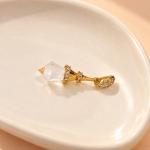
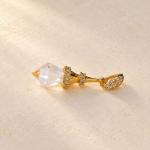
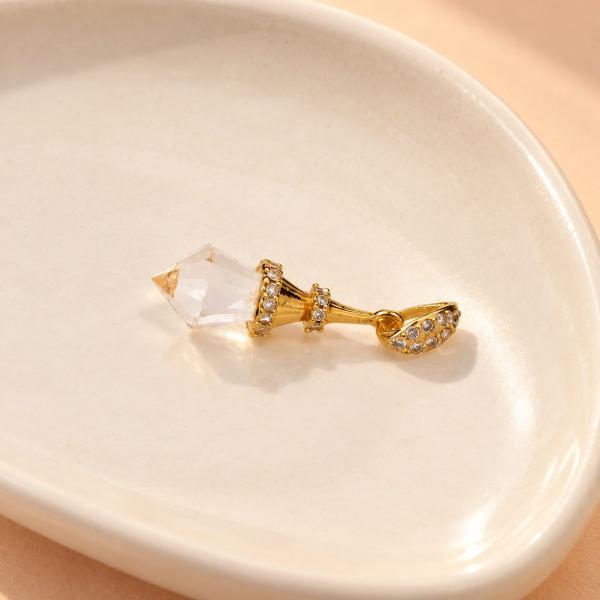
The pointed drop is a water droplet drawn out long: gathered to a point at the top, rounded at the bottom, and narrowing steadily in between. The shape appears in old silverwork and is common in European pendants too; what differs is the faceting. A pointed drop in a polished finish reads warm, and the same drop faceted reads sharp — two entirely different temperaments from one outline, which is the whole reason the cut matters.
The quartz is faceted, every face flat. Light entering bounces between faces, and a small turn of the wrist swaps which plane is lit. Faceting wastes more material than a smooth curve: the rough stone has to be cut with allowance, and what is ground away is cost. This one carries a moderate number of facets — enough that the edges read clearly, not so many that the light shatters into a single white blur. Cut too densely and the stone goes soft and white at a distance. The arrangement follows the point, faces widening as they descend from the tip.
The copper is worked into a cap over the upper point, with a loop left at the top. Wearing the point downwards is the usual way: the weight sits low and the pendant lies against the chest. Turned point upwards it reads differently, more like a shuttle standing on end. Both work; it depends which you want. The cap's mouth is drawn tight so the stone cannot rattle inside it. A shallow groove runs around the side of the cap, reading as a band.
Faceted quartz has one failing: dust lodges along the edges, especially the ring of them next to the copper cap. Clean with a soft brush along the lines of the facets, not a cloth rubbed back and forth — over time that dulls the edges. Dulling does not affect transparency, it only takes the crispness off the shine. Take it off before showering; limescale dried in the facet joints is harder to remove than dust. And do not bag it straight after wiping. Leave it ten minutes to air first.