


Menu
By theme
By theme



{{ variable.name }} : {{ variable.values[selectedVariantsIndex[variable_index]].name }}
Quantity:
In traditional patterns the butterfly stands for dié, the word for a person of eighty; that is why a cat painted with a butterfly is called a mao-dié picture and given as a birthday wish. The pun goes back to the Song dynasty and appears often on Ming and Qing textiles and porcelain. Made into jewellery, most people simply find it pretty, and not knowing the layer of meaning does not affect wearing it. Those who do know choose the motif when buying for an elder. The composition of a mao-dié picture is not fixed; cat and butterfly can swap places.
Side-hanging is one way of fitting a charm to a bracelet: not at the centre but off to one side, near the outer wrist. Raise your hand and the charm shows; lower it and the charm hangs aside and stays out of the way. Side charms are usually a size smaller than centre ones, since a large one swings about. Set the attachment too far from the guru bead and the charm slides towards the back of the hand. The hole for a side hang is normally beside the guru bead, so the main line is not disturbed.
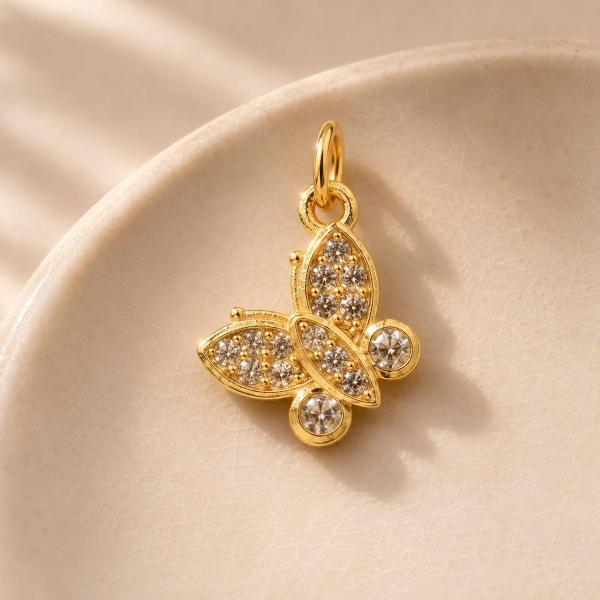
The wings here are open — four of them, the upper pair larger than the lower, with zirconia set into the surfaces. The body is made in segments and the antennae are very fine, which is where damage happens first. The wing tips curl slightly rather than lying flat, and light pauses on the curl. The two sides must curl by the same amount; unevenly and the butterfly looks as if it is flying crooked. The four wings do not weigh the same, so hanging it always tilts a little.
Copper base, white zirconia. The wing edges are rolled over, so from the side they have thickness instead of reading as sheet. The roll keeps the edge from cutting and, less helpfully, gives dust somewhere to sit; clear the gap with a toothpick. Go gently — the roll is thin and pressure turns it out. The seam between wing and body is a fine line that hides dust and hides adhesive equally well. The backs of the wings are flat and unpatterned, so they do not press into skin.
A side hang needs an attachment point: usually a small ring added between two main beads, or the side hole of the guru bead itself. Choose a point that takes load steadily, not a slip knot. The antennae face outwards, so be careful not to press the piece against a desk. If you type a lot, fit it to the inner side of the bracelet on your working hand to reduce knocks. Use brass for the ring between beads, since the colour sits close to the butterfly.