


Menu
By theme
By theme

{{ variable.name }} : {{ variable.values[selectedVariantsIndex[variable_index]].name }}
Quantity:
On a bracelet, one leaf sits at the centre with plain beads either side. On a necklace, use three as a group, staggered in size. The copper is on the yellow side: with pale beads it looks clean, with dark ones it goes deep. In a group of three, drop the middle one slightly lower and the grouping gains layers. Work out the total drop first; hang them too low and the leaves fall past the neckline.
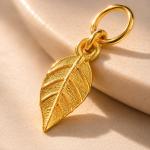
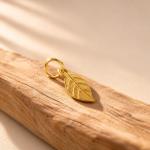
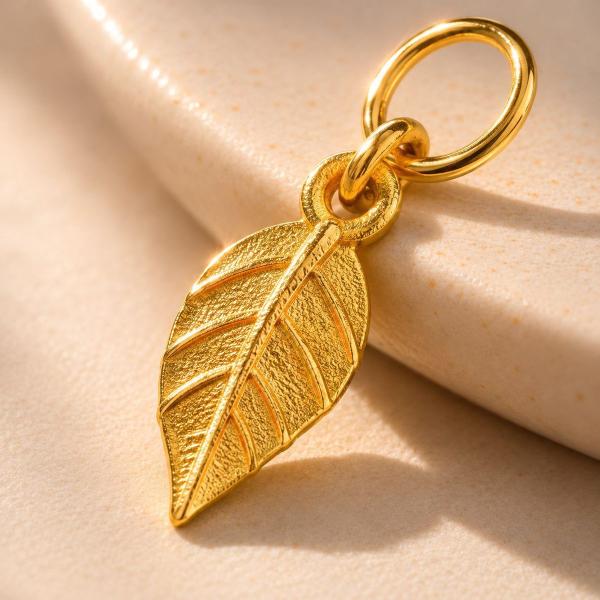
Which tree the leaf is taken from is hard to say. The veins are pinnate and the edge finely toothed, closer to an elm or a hackberry than anything else. Made as a pendant, the stalk is bent into a loop so cord can pass straight through. The opening is left wide enough for a thicker cord. The midrib runs as a straight line, and the side veins leave it at a consistent angle.
New Chinese style has been used loosely in recent years. It roughly means taking traditional elements apart, keeping only the form and the intention, then rebuilding them at modern proportions. This leaf belongs to that category: the motif is old, the execution is plain, and there is no surplus of scrolling vine or cloud head. How far the reduction goes you can see on the back, which carries nothing but the veins. Subtraction like this is not easy. Adding a stroke is simple; taking away to exactly the right point is the hardest part. The trap in this style is filling the surface with elements, and once it is full you are back where you started.
Veins appear on both faces, deeper at the front and shallower behind. The sheet is not thick, and the edge is rounded so it cannot cut cord. The tip lifts very slightly, giving a shallow curve when hung that is livelier than a flat plate. The curve is pressed in rather than bent by hand; bent curves are never even. The stalk end is a little heavier, which is where the leaf takes its load. The teeth along the edge are cut shallow — smooth at a distance, serrated close up. Both faces are polished, and the back is no coarser than the front.
What a copper leaf fears most is a fold. The sheet is thin and bends under force from the wrong direction; it can be bent back, but a mark stays. Store it flat, and do not press it inside a book — a crease made by pressing is harder to lose than a bend. When it oxidises, wipe with a silver cloth in one direction rather than in circles, since circles leave a haze on the face. The metal is thin, so keep the pressure light; bow the leaf and it stops looking right.