


Menu
By theme
By theme


{{ variable.name }} : {{ variable.values[selectedVariantsIndex[variable_index]].name }}
Quantity:
The pinwheel is a folk toy: paper on a bamboo stick, spinning as you run. It carries a second meaning too, blowing bad luck away. The Dutch windmill is a different object altogether, built for drainage, and the two should not be confused. As for meaning, the four leaves are enough on their own; the pinwheel only adds a motion. That layer of motion is common in modern jewellery and is not traditional, which is worth knowing if you are buying it for the motif rather than the look. A paper pinwheel spins fast; a copper one does not spin at all, it only looks as though it might, and that is the whole trick of the piece.
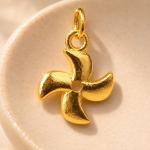
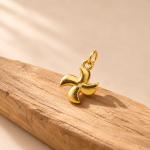
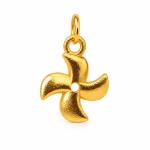
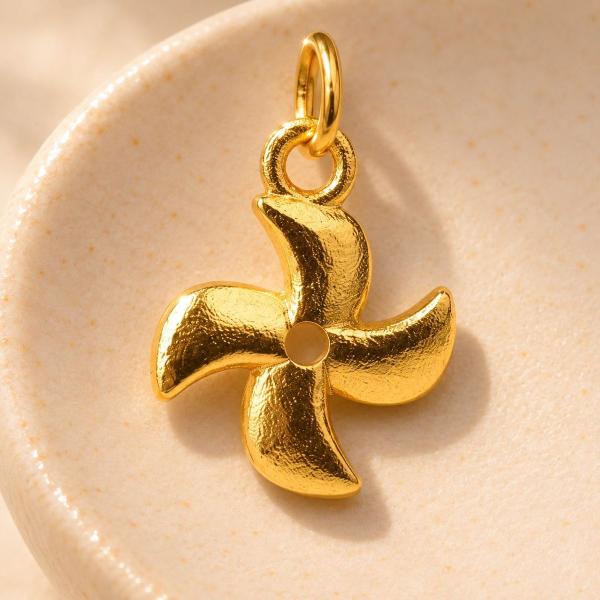
The four blades are set at a slant, each leaning the same way, so the piece looks about to turn. The angle is put in deliberately: blades laid flat carry no suggestion of movement. All four match; a small difference reads as crooked. A pinwheel's blades are made to catch wind, and as jewellery they catch light instead. The blades are uniform in width, tapering evenly from hub to tip, so no single blade draws the eye.
Gold-plated copper, bright yellow and newer-looking than plain copper. An axle runs through the four blades, with a small round boss at the centre and a loop soldered to the back. The gaps between blades are left fairly wide, so you can see through to whatever is behind. Wide gaps keep it light; they also mean the strength rests on the hub alone, which is why the centre is the one place worth checking now and then. The blade edges are rounded, so even a spinning pinwheel would not cut a hand.
On a bracelet the pinwheel turns with the wrist, showing front and back by turns. On a necklace it belongs at the side; at centre it would break the line of the neckline. The diameter is small, too small for a main pendant and just right as a companion to one. With a fine chain it sits just outside the collarbone and moves as you walk, and the small scale keeps it from reading as a brooch. A finer chain is what lets the lightness register.
Plating dislikes abrasion, and the blade tips are the outermost edge, so they lose colour first against anything hard. Store it on its own rather than in a pocket with keys. If the copper starts to show, the colour turns from yellow to a dull red; a touch of clear nail varnish on the edge keeps air off and slows it. Renew the varnish every six months — when it fails it flakes, and flaking looks worse than wear. The gaps between blades let a cloth in when you wipe it, which matters more on a pierced shape than on a solid one.