


Menu
By theme
By theme

{{ variable.name }} : {{ variable.values[selectedVariantsIndex[variable_index]].name }}
Quantity:
Openwork saves material and weighs less; the piercing is also the ornament, since the openings are what you see first. A solid copper pumpkin has a heft to it; pierced, the weight drops by half and it no longer drags on a small strand. The price is strength — squeeze it and it deforms. The weak points are the narrow strips between openings, which are the thinnest part. Do not drop it in a pocket with hard objects; one press leaves a dent. The sheet is bent into a curve with the seam at the back, so no join shows at the front.
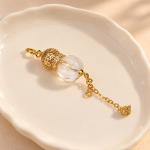
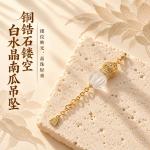
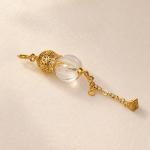
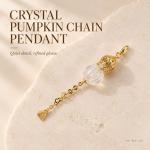
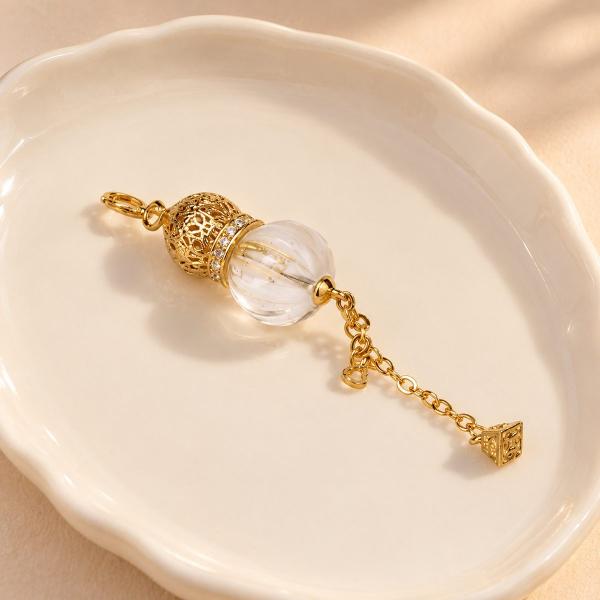
The openwork pumpkin is the body of this dangle. The sheet is bent into a gourd shape and diamond openings are cut through it, with clear quartz set into the openings so the back of the stone is visible from outside. The openings are lozenge-shaped with sharp corners, and light passing through casts a flower-shaped shadow on the ground. The shadow is incidental; what was wanted in the making was transparency, and the shape of the opening was chosen for that. The body's curve draws in from top to bottom, gently, without coming to a point.
The quartz is a round bead, one set at the front with a few zirconia around it. Stone and metal meet under a bezel that presses on the quartz's edge and keeps it from falling through the opening. The bezel runs all the way round rather than in claws, so the front reads as a clean circle. The zirconia are small and set outside the bezel, there to lift the piece rather than compete with it. The bezel is a hairline in width; any wider and it would cover the stone's light.
A small cap sits on top of the pumpkin, with the loop on the cap. Below hangs a tassel on the wine-red side. The proportion is small above and large below, the tassel taking about half the total length. A small copper bead sits between tassel and body, easing the transition and covering the knot. The loop is dead centre, so the pumpkin hangs true instead of tilting. Tassel colour and the warm yellow of the copper sit together without friction, both low in saturation, so neither one takes over.
Openwork is awkward to clean. Dust inside the openings needs a soft brush pushed through, not a needle, which will bend the sheet out of shape. Do not soak the quartz; water that gets behind the bezel dries slowly and eventually turns green. A soiled tassel can only be spot-cleaned with dry-cleaning fluid — immerse it and it comes apart. Store the piece flat with nothing on top; once the pumpkin is flattened it does not come back, and the loss shows at the openings first.