


Menu
By theme
By theme

{{ variable.name }} : {{ variable.values[selectedVariantsIndex[variable_index]].name }}
Quantity:
Of five-petal flowers in traditional pattern, the plum blossom is the standard example. It has five petals, and folk usage matches them to the five blessings — long life, wealth, health and peace, love of virtue, and a good end — a list from the Hong Fan chapter of the Book of Documents. The idea is widely known, and any five-petal piece draws on it to some degree. Others simply see a flower, and there is no requirement to know the reference. Plum opens at the end of winter; five petals are simple to draw and save brushwork, which is why the form appears so often on ordinary objects. There are several versions of the five blessings; this one, from the Book of Documents, is the most often quoted.
An end clasp is the piece that closes a necklace or bracelet, with the working clasp hidden behind it, so from the front there is only a flower. That is cleaner than an exposed clasp, especially on a fine chain where a metal fitting breaks the line. The back has to be flat; anything standing proud will press into the skin. The flower's edge is rounded, so it does not scrape the neck. Its diameter is a little wider than the chain, which is what makes the transition smooth.
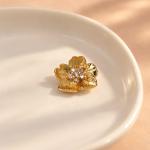
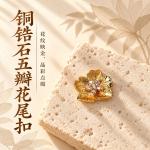
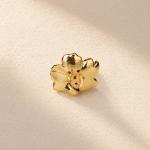
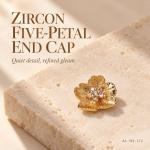
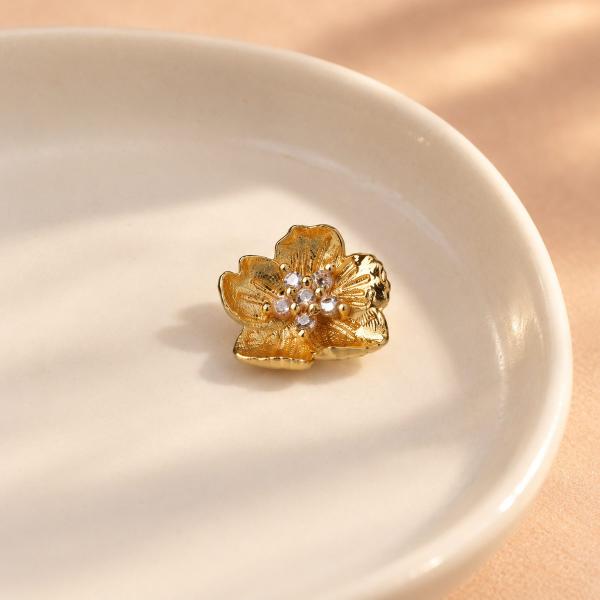
Copper base, with zirconia on the petals: one at the centre and five at the tips. The centre stone is slightly larger and leans white. Deep grooves separate the five petals instead of letting them merge into a disc. The bottom of each groove is left unpolished and matte, which sets off the brightness of the petal faces. The contrast is strongest in moving light — turn the piece and the bright area shifts. The five small stones form a ring at even spacing.
The back is flat with a small ring, and the clasp attaches to that ring. An end piece must be light: too heavy and it pulls the chain down, and on a fine chain the joint breaks easily. The ring is a split ring, so use two pliers to fit the clasp — one holding, one opening — rather than forcing one side. Bend it out of round and it will not close properly, and the clasp will rotate. Match the ring's gauge to the clasp's loop; a slight difference and it will not go on.
The stones are set shallow with thin edges, so do not scrub with a cloth — catch one and it lifts. Wash with a soft brush and soapy water, rinse, and dry at once. When the copper darkens, wipe the raised petal faces with a silver cloth and leave the recesses dark, which looks better anyway. Soap residue in the grooves comes out with a toothpick, not a needle. The piece is rarely taken apart; checking the ring once a year is enough.