


Menu
By theme
By theme



{{ variable.name }} : {{ variable.values[selectedVariantsIndex[variable_index]].name }}
Quantity:
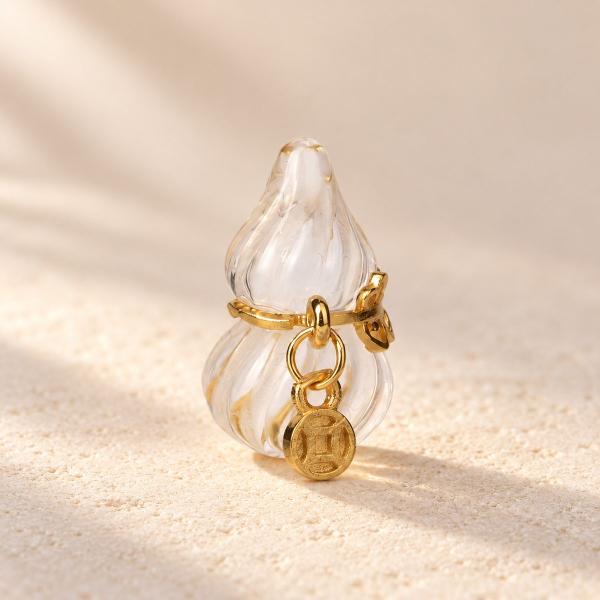
The lower half of the gourd is clear quartz; the upper half and the spiral are copper. The quartz is polished, not faceted, and held to the light it shows internal veiling. Veiling is common in natural quartz and is not a flaw. Stone with none at all is more likely glass. How much there is does not affect use, only appearance, and some buyers look for it precisely because it proves the material is stone. The gourd's base is round, so it will rock on a table; store it on its side, where it will stay put.
The spiral starts at the gourd's waist and winds upward, each turn lying over the last, closing into a small knot at the top. The line is not applied to the surface; it rises out of the copper, and from the side it has thickness. Even thickness means the twisting was done at steady pressure, and this is the stage that tests the hand most. There are not many turns — more and they would crowd together and the layering would be lost, so the space between turns matters as much as the turning.
Spirals appear early in ornament: on Majiayao painted pottery, and in the curling thunder patterns of Shang and Zhou bronzes. Both carry the same sense of movement. There is no settled meaning attached — it is closer to rhythm. Rhythm is hard to explain; look at it long enough and it seems to move, which is not what a static ornament is supposed to do. Spirals run both left and right, and archaeology classifies them finely, which a piece of jewellery need not. The Majiayao spirals are mostly black pigment on red earthenware, drawn in flowing lines.
The loop is at the top, joined to where the spiral closes. The whole line tapers downward, widening from loop to base, which reads as stable. The edge of the base is rounded, so it does not dig in against skin. The copper upper sphere is a size smaller than the lower, and where the spiral reaches the waist it lands on it without breaking off short. The loop's opening faces forward, so threading a chain needs no turning.
Dust settles in the channel between turns; clean along it with a soft brush rather than across. Copper oxidises, and the channel darkens first while the raised spiral stays bright, a contrast that sharpens with wear. To push it further, wipe only the raised line with a silver cloth and leave the channel alone. Do not poke at the joint between quartz and copper with a toothpick — loosen it and water gets in. The dark in the channel does no harm; it reads as a drawn line rather than as dirt, which is the useful part of an oxide.