


Menu
By theme
By theme

{{ variable.name }} : {{ variable.values[selectedVariantsIndex[variable_index]].name }}
Quantity:
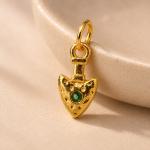
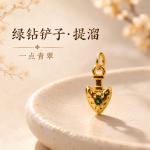
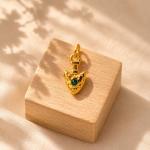
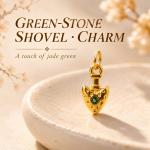
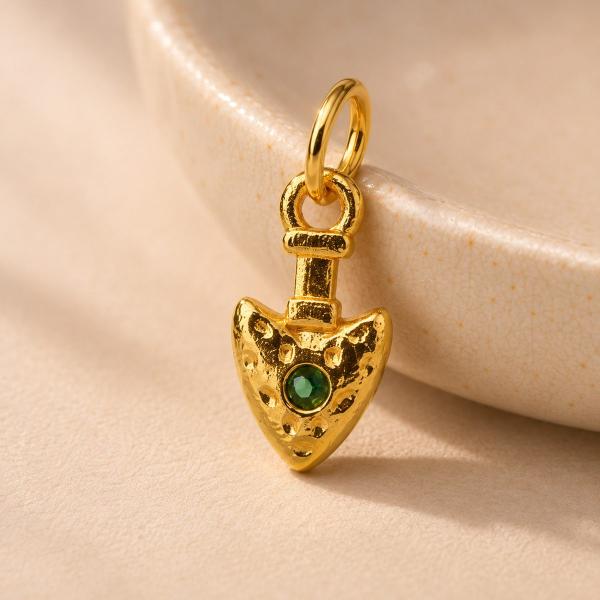
A spade made into a charm is a slight surprise at first glance. Tools that enter jewellery usually get smoothed into something rounder; this one has not been. The head is square, the edge given a thin bevel, the shaft a plain round rod closing into a loop at the end, and the green stones are set where shaft meets head, each one overlapping the next. It doesn't read as proper jewellery so much as someone having taken the smallest tool out of the box and tied it to a cord.
Brass has a blunt kind of shine. It is not the floating brightness of plating but the colour of the metal itself once polished, and left alone it darkens towards a brownish yellow. The green stones are cool in tone, and against warm brass the contrast is stronger than you would expect; after a while it settles into looking right. The thickness of the metal shows most clearly at the edge of the head, where the thin bevel lets a little light through and the solid part reads as dense.
The outline is simple: a straight shaft, a square head, a few strokes and it is drawn. That plainness stands out among the elaborate auspicious-beast subjects, and it divides people. Those who want detail find it empty; those who care about line like it for exactly that. Round off all four corners of the head and the piece loses its temper and stops looking like a spade. Historically it served as both farm tool and weapon, and the form barely changed for a very practical reason: it worked. Simple shapes are harder to get right than busy ones, and this one has nowhere to hide.
Watch the loop at the top. A single-thickness brass ring will draw out into an oval over time, so a heavier gauge or a double ring is steadier. Use a thicker cotton or leather cord rather than fine silk thread, which wears through quickly on brass. The corners of the head are genuinely square, and worn against the body they will prod a collarbone when you turn; through thin clothing you will feel it.
Brass is not plated, so oxidising is its nature rather than a fault. Want it bright, run a silver cloth over it; want it deep, leave it alone and the colour will darken of its own accord. Pair it with plain strands — dark-ground beads such as star-and-moon bodhi or coconut shell — where brass sits on top without fighting; against a fully carved strand the two sets of detail eat each other. Put it first below the guru bead, where the eye lands first. Green stones read colder against brass and go almost black in low light, which is normal.