


Menu
By theme
By theme


{{ variable.name }} : {{ variable.values[selectedVariantsIndex[variable_index]].name }}
Quantity:
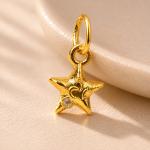
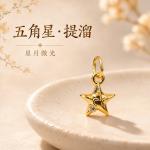
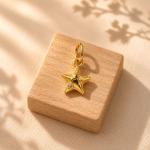
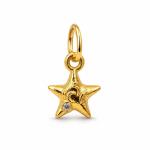
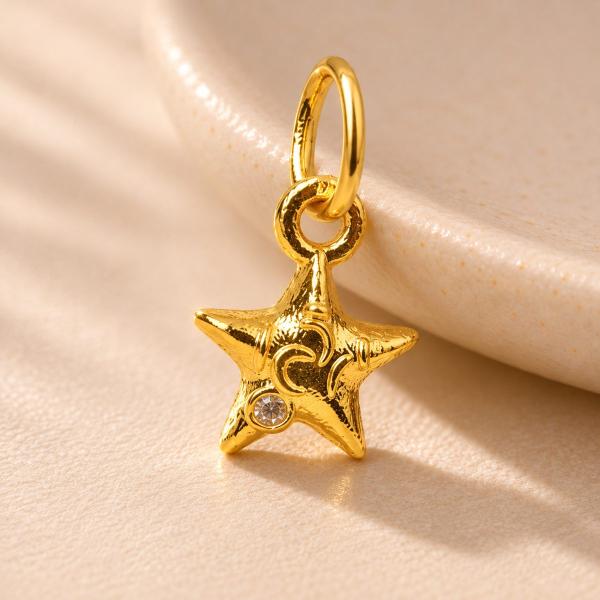
A five-pointed star is easy flat and hard in three dimensions. This one is textured on the copper first and plated afterwards: the points are not flat but carry a fine, dense dimpling on every face, as though worked over with a small hammer, so light breaks into many small points instead of gathering into one bright line. The valleys between the points cut deeper than the faces, and the shadow separates the five arms so the outline holds from a distance. Flat, the star would be a sticker; the hammering is what gives it a body.
The gold layer is thin by the nature of the process, not through cutting corners. Keep it away from hard objects when worn — rings, watch cases and keys all leave scratches, and a scratch deep enough exposes copper, which reddens first and then darkens, at which point no amount of polishing brings it back. Edges go first: the tips of the points and the inside of the hole. Once those two places are marked, the whole piece looks old. That is the trade built into plated work rather than a fault in this piece.
The five-pointed star is not an old motif in Chinese usage. The traditional five stars are the five planets — Jupiter, Mars, Saturn, Venus and Mercury — and a Han-dynasty brocade carries the phrase about the five stars rising in the east and benefiting China. Those five are not this geometric star. This piece is a modern shape and needn't be forced back onto old texts; recognising it as a star is enough.
The hole is drilled through the top point, so on a cord the star hangs with two arms down and its centre of gravity low; walking produces a small swing rather than a flip. On a fine chain it sits well at the collarbone; on a heavy chain it looks top-light. If the chain is short the star lodges in the hollow of the collarbone and rubs when you turn, so err on the longer side. It has presence, and one is enough — no need to layer other pendants with it. With one point towards the chin it reads most like a pendant; worn upright it looks more like a badge.
The depth of the texture varies, and under a fingertip it feels grainy, with a direction you can trace. A surface like this ages better than a polished one and tolerates small scratches, because they disappear into the pattern. Store it on its own: plated pieces suffer most from being heaped in a box with other metal, and a small velvet pouch saves a great deal of refinishing. The gold tone is warm, so it clashes with silver jewellery but sits happily with leather cord and wooden beads.