


Menu
By theme
By theme







{{ variable.name }} : {{ variable.values[selectedVariantsIndex[variable_index]].name }}
Quantity:
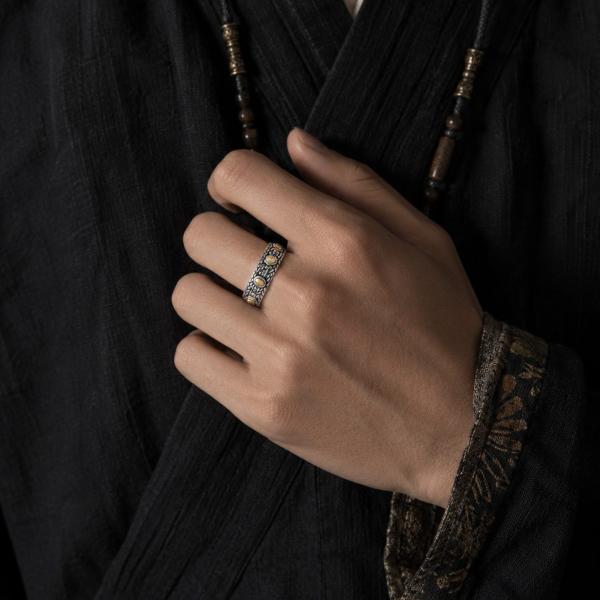
The seven grains of rice design is, plainly, seven grains lined up in a row. A grain is pointed at both ends and full in the middle; shrunk down it becomes an oval, and the effect comes from how tightly they are spaced and the angle each one tilts at. Lined up too evenly they look like a zip, too loosely like scattered gravel, and the middle setting is the hard one. Each grain usually gets a slight dome so the light leaves a thin highlight along it — flat, and the whole thing dies.
Seven holds a particular place in the tradition. The Book of Changes, in the Return hexagram, has the phrase about returning after seven days, describing the cycle in which the first yang comes back; the seven-day mourning rites, the seventh night of the seventh month and the seven governors all borrow the number. Rice is one of the five grains, and with food the people's first concern, turning grain into ornament is a plain kind of valuing — far more discreet than carving a great ingot. Of the five grains — rice, millet, broomcorn millet, wheat and beans — rice is the one the south knows best.
This is an open ring with the seven grains set across the bezel and fine gaps between them. Where the gaps are right, each grain takes its own load as the finger bends instead of the row pushing as one; soldered too tightly, the face reads as a single polished arc with no grain at all. That is the dividing line in the workmanship, and it barely shows in photographs — you have to handle it. If the bezel is too narrow for seven, the count drops to five, and then it no longer goes by this name.
Small silver grains wear smooth. The raised parts meet skin and desk every day, and within six months the edges round off, after which the grainy quality fades. To keep them crisp, take the ring off for manual work and don't type in it — the area against the finger pad wears fastest. Once rounded, a little polish on a leather scrap, worked in one direction, brings some of the edge back. A grain that has gone completely flat can't be raised again, only replaced.
The subject doesn't divide people. For an older relative it carries the sense of enough food and clothing; for a peer it doesn't look matronly; the price is modest and it works as an everyday change of ring. Wipe the residue of hand cream off the base of the finger, or the gaps between grains collect a white film that looks like tarnish and comes off in one wash. Wearing rings on both hands, put the grains on one and a plain band on the other and they won't compete. Don't expect the size adjustment to cover two full sizes.