


Menu
By theme
By theme

















{{ variable.name }} : {{ variable.values[selectedVariantsIndex[variable_index]].name }}
Quantity:
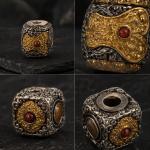
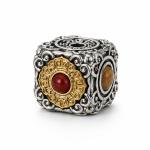
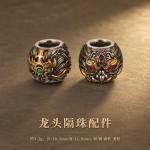
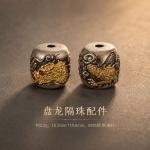
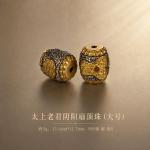
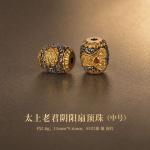
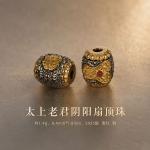
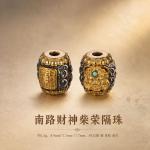
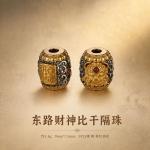
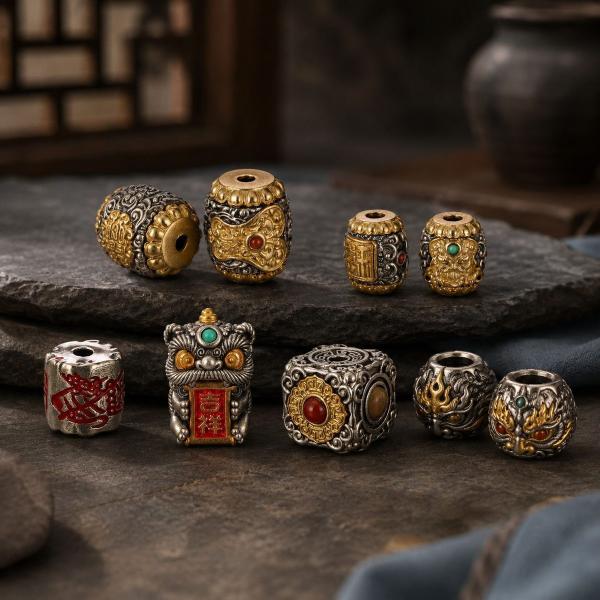
Six styles in this set, and they don't belong together: Lord Lao's yin-yang fan in a large and a medium size, a coiled-dragon fitting, a charnel-ground fitting, a lion-dance fitting and a health talisman fitting. They sit in one listing because all of them serve as charms or spacers on a bracelet, though the subjects come from three separate systems — Daoist, Tibetan and folk. If all six are priced the same, that price is per piece rather than by silver weight, which is worth confirming.
In painting the yin-yang fan is the object in the hand of Lord Lao; in Journey to the West he carries a palm-leaf fan, which is a literary touch and not the same thing as a Daoist ritual implement. The yin-yang in the name shows on the fan face as two different treatments, one closed and one open. On pieces finished on both sides, the workmanship is judged by how clean the division between the two is. The ribs of the fan need to hold their shape; a floppy fan shrunk down becomes a disc, and nobody can see a fan in it.
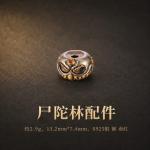
Charnel ground is the Tibetan cold grove, the woodland where the dead were laid out; its lords are the protectors of that place, shown as two skeletons dancing, and they stand for impermanence. The subject has less traction in Chinese-speaking markets than dragons and phoenixes: few makers produce it and few recognise it, and most people buy it for the pair of skulls rather than the meaning. Skulls are hard to do at small scale, and get the proportion of the two heads wrong and it turns into a toy.
The lion dance in question is the southern style from Guangdong, where the lion head carries one of three painted faces — Liu Bei, Guan Yu or Zhang Fei — in red, black or white, with the mane and the mirror on the forehead as the identifying points. A fitting usually takes only the head without the body, which makes the colours and patterns of the face all the more critical; a little off and the character goes. If the forehead mirror is polished it catches the light sharply, and that is the most conspicuous point on the piece.
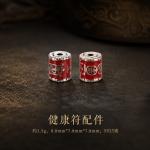
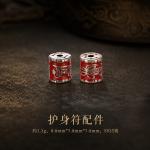
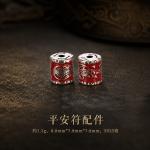
Health talisman is a folk term, drawn differently from place to place with no standard form, and that should be said up front so nobody expects the authorised version of a particular school. On silver fittings, check the hole position and the thickness: a charm's hole is at top centre so that it hangs straight, a spacer's is through the side so that it sits between main beads. All six on one strand is a muddle; one or two subjects are enough. On fittings, the chamfer at the hole matters more to how long the piece lasts than the pattern does, so feel the hole before buying.