


Menu
By theme
By theme


{{ variable.name }} : {{ variable.values[selectedVariantsIndex[variable_index]].name }}
Quantity:
The Yellow Emperor, touring the east, reached the sea and met a beast that could speak, calling itself Baize. It named and described every spirit and prodigy in the world, the emperor had it written down, and the record became the Baize Register of Prodigies; material of this kind survives among the Dunhuang fragments. The texts that carry the account are grouped as the Baize Chart tradition. The original is lost, and what can be read today are reconstructed editions — fragmentary in content, but still clear in arrangement.
Baize is not the most famous of the auspicious beasts, but its business is specific: knowing the names of things. Names carried weight in ancient thinking — know the name and you can deal with what bears it, which is the logic behind books like the Baize Chart. Pictures of Baize differ from place to place; some make it lion-like, others a horned qilin, and there is no fixed type. The habit of mind persists in folk practice today, in the way a name is chosen for the meaning behind the character.
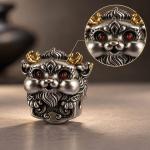
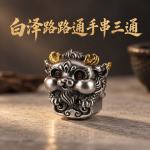
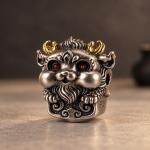
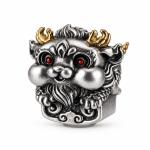
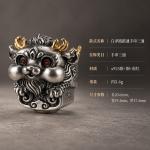
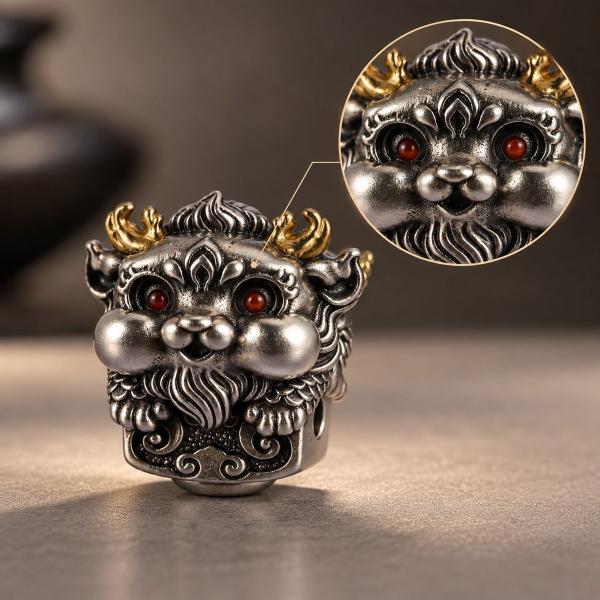
This one takes the form of a sliding bead, a hollow barrel threaded so that it travels along the cord — the name puns on everything running smoothly. With the Baize relief added it also serves as a three-hole guru bead: three holes, the main strand passing through from both sides and a pendant hanging from below, one piece doing two jobs. The bore has to be straight; drill it at an angle and the bead won't slide, and a bead that won't slide has lost the point of the form.
A guru bead sits at the junction of the whole strand, and the stock for one has to be thicker than an ordinary bead, or three holes leave the walls thin. The walls here look adequate, and the hole mouths are chamfered. A silver guru bead frays cord, particularly at the lower hole, where the weight of the pendant bears; pull the cord out now and then to check, and replace it at the first sign of fuzz. Made too thick, a guru bead bulges at the head of the strand, so the proportion has to be kept in check.
With a subject like this there is no point arguing over correct and incorrect, since Baize never had a standard image and every maker draws it their own way; it is enough that the beast holds together and looks right. In use a guru bead usually pairs with the head bead and there is only one on a strand: its job is to gather, not to decorate, so it only needs to sit under the main beads in tone, not to compete. Don't use fine cord with a silver guru bead — fine cord wears fastest in the bores, and one size up buys another year.