


Menu
By theme
By theme


{{ variable.name }} : {{ variable.values[selectedVariantsIndex[variable_index]].name }}
Quantity:
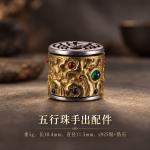
Five beads — blue-green, red, yellow, white and black — matched to wood, fire, earth, metal and water. The correspondence was already fixed in the Han, and the five colours, five directions, five organs and five tones all slot into it: a framework for sorting the world, not merely a matter of colour harmony. The pairing is not arbitrary. Blue-green belongs to spring, red to summer, yellow to the late summer, white to autumn and black to winter.
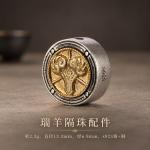
The ram is another matter. In early script the character for sheep served for auspiciousness, and on Han bronzes and roof tiles auspicious ram simply means good fortune. The saying about three yangs opening into peace comes from the Peace hexagram in the Book of Changes: three yang lines rising from below, matching the end of winter and the coming of spring. The horns are the difficulty in carving, since a curled horn has to roll naturally; too regular and it looks like a spring, too loose and it stops being a ram. The subject flourished in the Han and appears on seal impressions, relief stones and bronze basins, mostly in auspicious phrases.
There are two options here: the five phase beads as a set, or the single ram. Plenty of buyers take both — five beads and one ram rounds out the theme of a strand — and in that case keep the ram neutral in colour so that it doesn't compete with the five; competition makes a muddle. The ram works better at the tail of a strand than in the middle. Buying the phase beads singly is harder than it looks: the five have to be chosen together for hue, and bought separately they will almost never match.
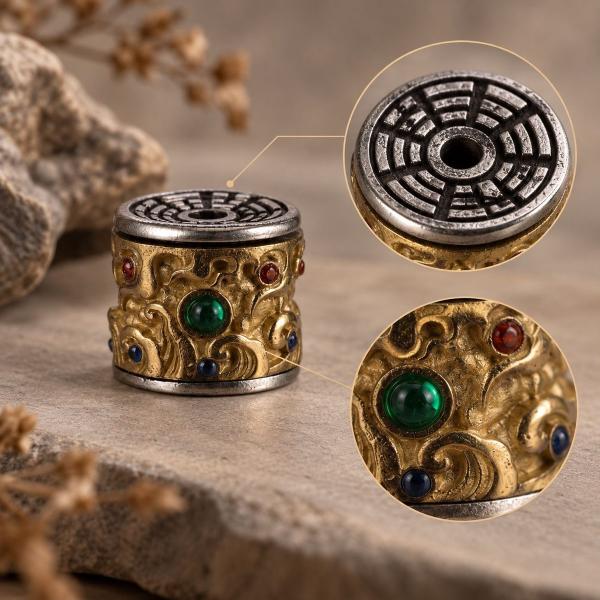
With the phase beads the question is whether the colours separate. Each of the five has its place, and the way to buy is to lay all five out together: if the hues blur into one another the set is wrong. On silver fittings the hole mouths need to be round. A burr at the hole will fuzz a cord in no time, and that is the commonest way a strung piece wears out. If the holes are off centre the beads sit crooked; five crooked beads show plainly, and laying a strand out straight will reveal it.
Five silver beads together are not light, and on a strand they pull the weight up; partner them with something lighter — wood or coconut shell will do, while all stone becomes heavy. Silver beads rub against each other and the contact faces polish bright, which is normal. Bag them for storage rather than mixing them with hard objects, since a dent is hard to fix. If the whole strand is silver, take it off before bed rather than sleeping in it. Rub marks between silver beads are round, and quite different from a dent.