


Menu
By theme
By theme


{{ variable.name }} : {{ variable.values[selectedVariantsIndex[variable_index]].name }}
Quantity:
A charm coin is not money. These were privately cast, never circulated, and shaped after the copper cash while serving to avert evil, to be worn, or simply to be enjoyed, which left their inscriptions and designs far freer than those of currency. The Shan Gui coin is the best known among them; surviving pieces are mostly Qing-dynasty casts, and the varieties are numerous, differing in size, inscription and reverse design, so collectors sort them by type. The category itself goes back to the Han dynasty, and these pieces were made to turn misfortune aside from the start, not merely to be looked at.
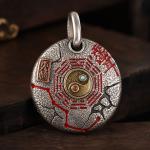
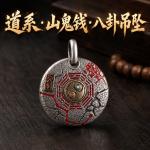
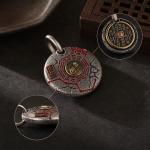
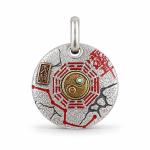
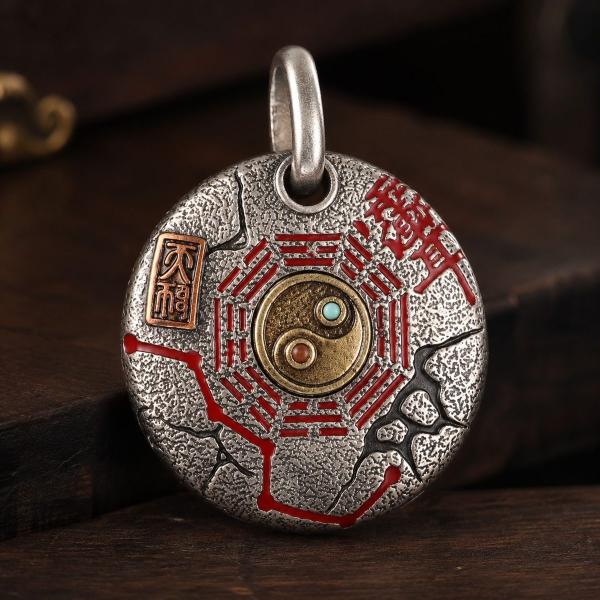
In the commonest layout the two characters Shan Gui sit on the face, ringed by a band of command glyphs whose strokes are drawn out and joined until they look like incantation rather than writing; the reverse carries the bagua, Qian, Dui, Li, Zhen, Xun, Kan, Gen and Kun set around a circle, with either a square or a round hole at the centre. This pendant keeps that structure, glyphs on one side and trigrams on the other, reduced to a size that hangs at the chest. The square hole is the standard form for copper cash, though charm coins show both square and round.
Charm coins cover a wide field: zodiac pieces, auspicious phrases, backgammon coins, palace coins, treasury coins, each with its own purpose. The Shan Gui coin belongs with the apotropaic pieces, its function tied to driving off evil, which is why its text is mostly talismanic rather than a reign title. When you look at an old Shan Gui coin you read the cutting of the characters first and the patina second, and only when both agree is it worth talking about type; this pendant is a modern silver piece and should not be judged by that standard.
Silver is ductile, so the relief can be pressed fairly deep; the yao lines of the bagua are raised straight strokes, and the gaps in a broken yin line are where the hand shows most, since an uneven break makes the whole ring of trigrams fall apart. The rim is rounded, so it does not cut the fingers. The glyph side is dense, which gathers dust and snags fibres from a cloth; wipe it in one direction rather than sawing back and forth. High points polish themselves bright while recesses stay dark, and with wear the piece settles into contrasts, which is why silver improves the longer it is worn.
A subject like this looks better on a cord than a chain: leather or cotton both carry the weight, while a fine chain makes the pendant look top-heavy. Watch the orientation of the bail when you string it, with the trigrams facing outward the right way up. Silver oxidises and dulls, and summer sweat speeds it up; press it over with a soft cloth when you get home to lift the salts, which is far easier than dealing with a blackened piece later.