


Menu
By theme
By theme

{{ variable.name }} : {{ variable.values[selectedVariantsIndex[variable_index]].name }}
Quantity:
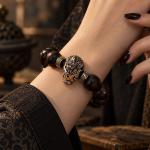
A three-hole bead has one hole in, one hole out and one facing down to hang a charm. It bends a straight run of beads into a turn, and the weight of the whole string gathers there. That is why it should be made a little heavier and drilled a little truer: strung carelessly it twists, and when the bracelet turns on the wrist the charm should still hang towards the back of the hand. The height of the holes decides where the charm sits; too low and it flips, too high and it crowds the main bead.
The word pixiu appears as early as pre-Qin texts, where it means a fierce beast ranked with tiger and leopard. Over the centuries it became the auspicious creature familiar in folk art: dragon head, horse body, scale-covered legs, lion-like, grey-white, and able to fly. Folk saying also gives it a mouth and no vent, so what goes in does not come out, which makes it a symbol of keeping wealth. That is an imaginative idea rather than a promise you can audit, and liking the shape is reason enough. Beast forms of this kind appear on Han-dynasty objects; the version we know was largely settled in the Ming and Qing.
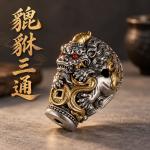
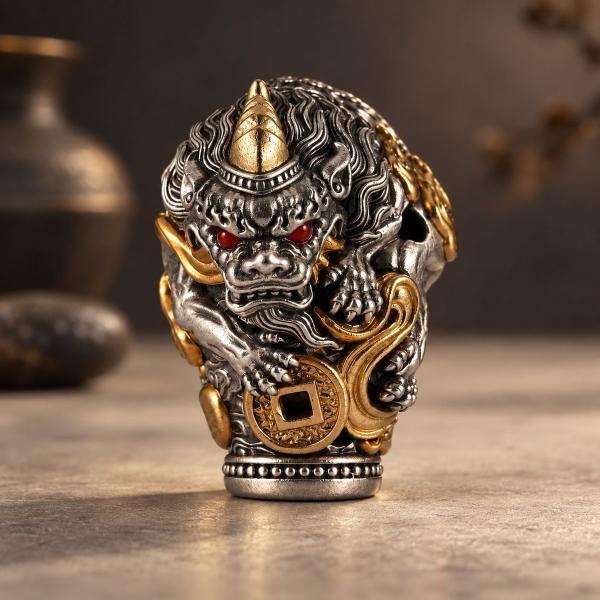
There is a further layer to the iconography: one horn makes it Tianlu, two horns make it Bixie, and no horn makes it Fuba. The three originally named separate creatures, but popular usage merged them and filed them all under pixiu. So a horned pixiu is not a mistake; it is a trace of the older names.
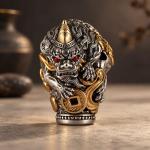
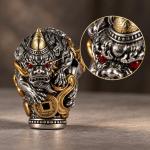
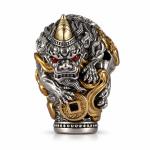
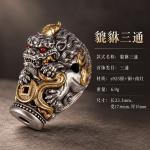
This one has its head tilted. Auspicious beasts are usually carved frontally and symmetrically, and the tilt is a deliberate break: the head turns to one side, the eyes slant away, and the face gains movement instead of sitting upright waiting for incense. The relief on the front is pressed deep, with the cheekbones and brow ridges standing up as edges, so there is real depth in profile; the back is flattened and the stringing holes sit at the base. A tall face against a thin rim keeps the piece from flattening into a blur under light, and holds its outline at a distance.
Try the stringing before you commit. Which way the head should lean depends on how the main beads are arranged: left or right comes down to the balance of the string and the direction you want it to face. A doubled cord is more secure, and the knot hides inside the holes so no ends show. The walls of the holes are thin, so do not haul on the cord; a melted, hardened tip will scrape burrs at the mouth of the hole.