


Menu
By theme
By theme





{{ variable.name }} : {{ variable.values[selectedVariantsIndex[variable_index]].name }}
Quantity:
Emperor Zhenwu, also called Xuantian Shangdi, is the Daoist deity of the north and holds high rank. Mount Wudang is regarded as his seat, and most of its temples are connected with him; the Ming court venerated him above other deities, and the saying that the dynasty built the palace in the north and Wudang in the south has circulated for centuries. It was in that period that his worship spread across the country. The temple complex on Wudang was built under the Ming, running from the foot of the mountain to the golden summit, and its main hall is dedicated to him.
His iconography is fixed: loose hair, dark robes, feet on a turtle and snake, a sword in hand. The turtle and snake are the essential markers. The northern constellation was itself called Xuanwu, and the coiled pair came from that star pattern; transferred to a human figure, they became a turtle and a snake beneath his feet. Identify the image by them rather than by the face. The sword was added later: early Xuanwu is only the turtle and snake, and the weapon arrived once the figure took human form.
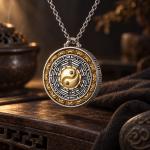
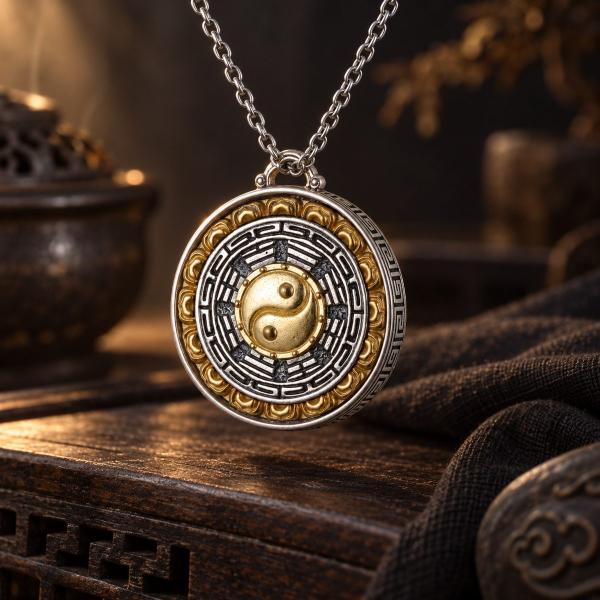
The Nine Palaces and the bagua are a separate system. The Nine Palaces come from the Luoshu, the numbers one to nine laid into a square by direction so that every row, column and diagonal totals fifteen; the bagua come from the Book of Changes, with Qian, Kan, Gen, Zhen, Xun, Li, Kun and Dui each governing a direction. In Tibet the two were combined on a round plaque, Nine Palaces at the centre and bagua around the rim, sometimes with a ring of zodiac animals as well, and carried as a protection charm. Some round plaques carry a further band of yao lines, densely packed; if they are hard to make out, that is no matter, since they are there for people who read them.
Putting two subjects on one pendant usually means splitting them between the faces, the deity on one side and the diagram on the other. In silver the figure needs deep relief while the diagram needs to stay shallow, otherwise the high points press into your clothes when you wear it turned around and the front of the shirt bulges. The thickness of the rim is a balance struck between those two demands. The faces also need an order of importance, the main one deep and the secondary one shallow, so that turning the pendant over does not look like a quarrel.
The Nine Palaces and bagua are about direction, so wearing the diagram outward is an unwritten convention; it does no harm to ignore it, and nobody uses a pendant to survey a house anyway. Silver dislikes sulphur, which is present in rubber bands and dark leather, and long contact leaves a yellow ring at the touching edge. Oxidation starts at the rim on silver: by the time that ring yellows, the rest of the piece still looks unchanged.