


Menu
By theme
By theme






{{ variable.name }} : {{ variable.values[selectedVariantsIndex[variable_index]].name }}
Quantity:
Ziwei refers to the Emperor of the North Star, one of the Four Sovereigns of Daoism, who dwells in the Ziwei Palace and governs the stars of the whole sky. Folk usage often writes it with the character for the crape myrtle, a flower of the same sound but a different character; on a shop sign nobody minds, but cut into a pendant the difference shows. This piece uses the Daoist spelling. Among the Four Sovereigns, Ziwei rules the stars, Gouchen rules arms, Houtu rules the earth and Nanji rules the span of life, a clear division of labour. The Ziwei Palace lies at the north celestial pole; the old astronomers set the seasons by the sky, and this star appears not to move while everything turns around it.
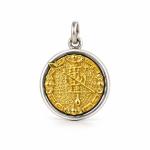
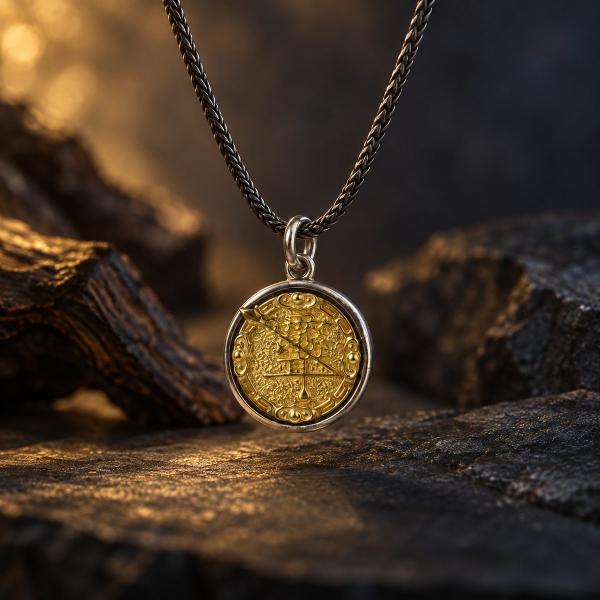
The Ziwei hui glyph is a compound, not a character in its own right. Its strokes are assembled from several parts, the usual form topped with the rain radical and coiled into a knot below, so that it looks like writing without being pronounceable. Daoism holds that such glyphs should not be written casually, that the writer needs a teacher's transmission, and that a mis-copy is worse than nothing, which is why what survives in folk use is often only the outline. The coiling is explained two ways: it hides the glyph from ordinary eyes, or it packs the strokes into a square to save space.
A round plaque has no orientation, so it wears the same either way round, which makes it easier to live with than a square one. The glyph sits at the centre with a plain margin around it, and the gap between glyph and rim needs to be generous; otherwise the character seems pasted against the border and the whole face feels cramped. The bail is joined at the top with the hole drilled on the centre line, so the plaque hangs straight. The edge carries a chamfer, smooth under the finger rather than sharp as a blade.
Thickness matters on a silver plaque. Too thin and the strokes cannot be pressed deep, so the lettering floats; too thick and the weight climbs until a day on the neck leaves it aching. The back is usually flat, though some are dished slightly, and the hollowed face sits closer to the skin and shifts less against clothing. A small difference in thickness makes a large difference in weight, and the neck is sensitive to it; a short try-on will tell you.
For a plaque with a glyph on it, a plain chain is the safe choice; a patterned one competes with the design. Over time dust settles in the recesses of the strokes and turns them dull: brush along the strokes with a soft brush, and never pick at them with a needle, because silver is soft and every jab leaves a pit. Choose a plain chain of moderate weight; a very fine chain cannot visually carry a round plaque.