


Menu
By theme
By theme






{{ variable.name }} : {{ variable.values[selectedVariantsIndex[variable_index]].name }}
Quantity:
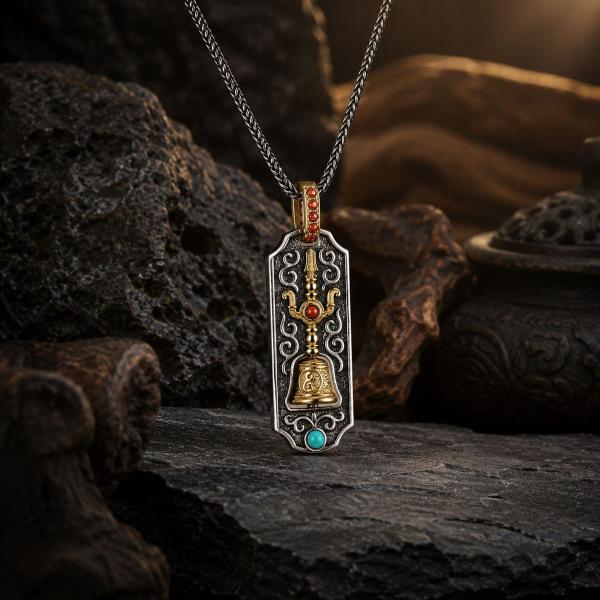
The Three Purities bell, also called the emperor's bell, is a ritual implement of Daoist liturgy. Its body often carries the glyphs of the Three Purities; the priest holds the bell in one hand and forms a mudra with the other, and the sound is used to call the deities and clear the space, at both the opening and the close of a rite. The tone should be clear and far-carrying: cast too thick it sounds dull, too thin and it skims. The body is circular in section, cast in one piece with the seam left at the side. The rhythm of ringing follows a fixed pattern, and the pace between slow and fast is a matter of rule.
The bell has three parts: body, clapper and handle. The handle is usually shaped as a sword or a three-pronged fork and is what you hold; the clapper hangs inside and works by swinging. Made into a pendant, the clapper mostly remains as a shape and does not sound, which is just as well, since a bell that rang as you walked would draw every eye. The three prongs of the handle stand for the Three Purities and should be level, because a small difference reads as a tilt.
Turquoise runs from blue to green with everything between, and its matrix is its identity card: dark brown veining running in a net, no two stones alike. Turquoise is soft and dislikes acid, sweat and perfume, and its colour deepens with wear; some people like that change and call it the stone being raised. Old mine and new mine are much discussed, and colour and matrix are the more reliable guide.
Nanhong is a variety of agate, running from cherry red to persimmon, and good material has a gelatinous quality, so light entering it glows rather than passes through. It is harder than turquoise and wears better. Set on one piece, the soft stone and the hard one have to be handled separately, and the hard one must never be allowed to rub against the soft. Nanhong red is warm and turquoise blue-green is cool, and side by side the two temperatures set each other off. Nanhong dislikes heat, so keep it off a radiator and out of hot water.
Turquoise must not go in an ultrasonic cleaner or be soaked, since water seeps in and leaves the colour chalky. Dirt collects where silver meets stone: use a dry cotton bud there, never a wet one. Spray perfume and hairspray before putting the pendant on; do it the other way round and the turquoise loses its lustre first. The stone is held in a silver setting whose claws press on its edge, and too much pressure will chip it. Both materials dislike knocks, and squeezed into a box with other jewellery, the stone face will always be the first to suffer.