


Menu
By theme
By theme




{{ variable.name }} : {{ variable.values[selectedVariantsIndex[variable_index]].name }}
Quantity:
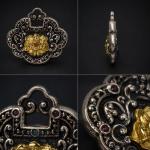
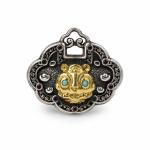
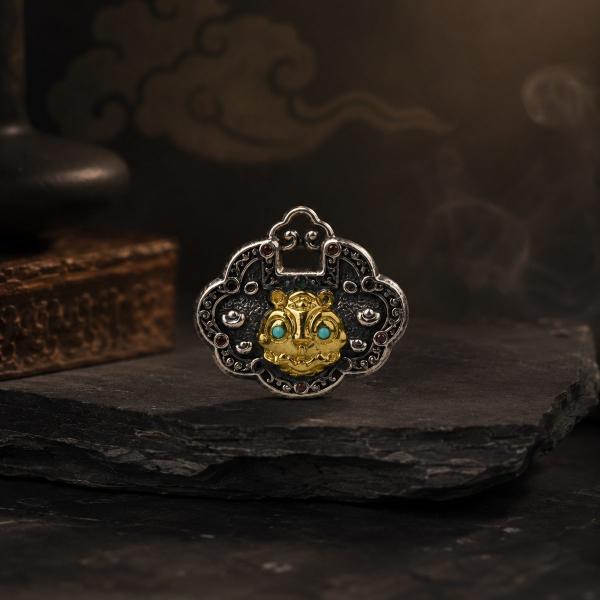
The long-life lock came into fashion in the Ming and Qing. A silver lock was made for a child and hung at the neck, its face inscribed long life and wealth or a hundred years of life, the idea being that the child's life was locked shut and could not be taken. Wealth lock is one name among these pieces, usually shaped as a ruyi head or an ingot and a little more elegant than a plain round plaque. The face is made thick or thin: too thin and it dents under a thumb, too thick and it hangs too heavy on a child's chest, so it takes a middle weight. What is locked is the life; what is tethered is the hopes of the elders.
The ruyi has a head of three curls on a straight shaft, a shape generally traced to the back-scratcher. In the Wei and Jin period scholars held one while they talked, and the object drifted from use to ornament to pattern, so that holding one came to mean that everything goes as you wish, layer added to layer. The three curls turn in one direction; reverse them and the form goes stiff, which is the clearest difference between a ruyi and a cloud scroll.
The beauty of turquoise is in the matrix. Dark brown veins run across the stone in a net, dense here and open there, no two alike, and that is what cannot be fully imitated. The word natural in the name only means the material is not synthetic; it does not mean the stone has had no stabilising treatment, since most turquoise on the market has been impregnated or colour-enhanced, which is normal in the trade. Ask the question rather than guessing. Matrix is not a flaw but the fingerprint of the stone, and completely clean material without veining is priced in another bracket.
A lock-shaped pendant carries its weight low, with bails at the two upper corners, so the face settles straight once strung. A fine cotton or leather cord works; a thick one through two holes looks clumsy. The plaque lies against the chest and shifts a little as you walk, not enough to be noisy. The distance between the two holes decides whether the lock hangs true: set them slightly out and it sits crooked.
Turquoise dislikes sweat, perfume and acid. In a heavy-sweating summer, press it with a dry cloth when you get home rather than rinsing it. Dirt hides most readily in the gap between stone and setting; lift it out with a dry cotton bud and never a toothpick, whose point slips and scores the stone. Turquoise deepens in colour as it is worn because it takes up oil, and that is not dirt.