


Menu
By theme
By theme

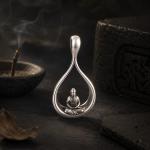


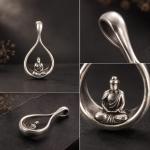
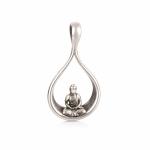
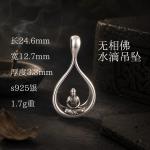
{{ variable.name }} : {{ variable.values[selectedVariantsIndex[variable_index]].name }}
Quantity:
The term formless comes from the Diamond Sutra: whatever has characteristics is false. Applied to an image, it means giving the Buddha no face: no eyes or brows, no expression, only the outline of a head and the folds of a robe, and the viewer fills in the rest. It is not the mainstream of Buddhist sculpture, but it has never quite stopped. The line in the sutra was originally about breaking attachment, and later makers borrowed it as a warrant for carving, which is a borrowed brief.
Leaving the face uncut removes the hardest part and gains an openness. A Buddha with a face can only show you one expression; one without shows you whatever you bring. Contemporary jade carving and silver work like the approach, half because it saves work and half because it genuinely holds the eye for a decade without tiring. With no face, the fall of light becomes the subject, and the bright and dark planes do the talking. Look long enough and you notice that a faceless image is harder to fake, because there is nowhere to hide a failure of nerve.
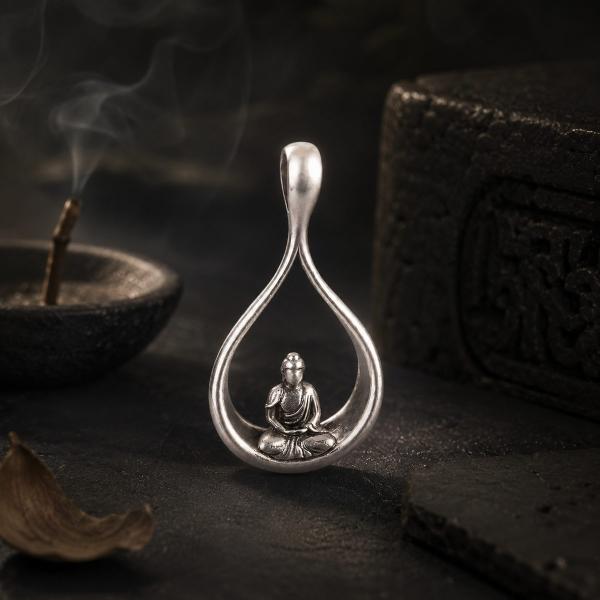
The teardrop is wide at the top and narrow below; the line of the shoulders follows that curve down, drawing in at the waist and releasing a little, which settles the whole form. The one thing this composition cannot bear is an even width top to bottom, which turns it into a capsule and takes away the seated posture. The plain surface has to be polished bright, otherwise the piece goes grey as though fogged. Both flanks of the drop must be symmetrical, since an uneven shape reads as crooked, and the eye can measure that without help.
The trouble with a plain surface is that it keeps every mark. Silver is soft enough for a fingernail to leave a fine line, and on a polished face those lines show plainly. There is no avoiding it: accept it, or send the piece back to be repolished now and then. In daily use, keep it out of a bag with hard objects and the rest looks after itself. Polishing runs in three stages: coarse to take out tool marks, medium to raise the shine, fine before a mirror appears.
The point of the drop faces down, the bail is at the top, and the weight sits below centre so the pendant does not flip. Choose a fine chain; a heavy one overwhelms such a quiet shape. Take it off for a shower, because moisture sits in the grooves of the robe and dulls them over time. Chain length changes where the pendant lands on the chest, and just below the collarbone is the safest placement.