


Menu
By theme
By theme







{{ variable.name }} : {{ variable.values[selectedVariantsIndex[variable_index]].name }}
Quantity:
The nine-syllable mantra comes from the inner chapters of the Baopuzi, written by Ge Hong in the Eastern Jin, where it is called the Secret Invocation of the Six Jia; the nine characters run lin, bing, dou, zhe, jie, zhen, lie, qian, xing. The book says that reciting them on entering the mountains keeps what lives there at a distance. In that context it was a technical art with no Buddhist connection. The instructions are specific: entering hills, fording water, walking at night, say the words. The invocation contains other lines as well, and the nine are the stretch most often taken out and used alone.
The nine later reached Japan, where they became the nine hand signs of Shugendo and of the ninja, recited together with finger knots whose details differ from school to school. Tibetan tradition has a corresponding set, arranged and explained somewhat differently from the Chinese, and the same syllable does not carry the same weight on both sides. Anything that crosses cultures changes shape, and that is ordinary. In Japan the practice attached itself to the mountain ascetics, who form the nine signs before a climb and recite them on the way.
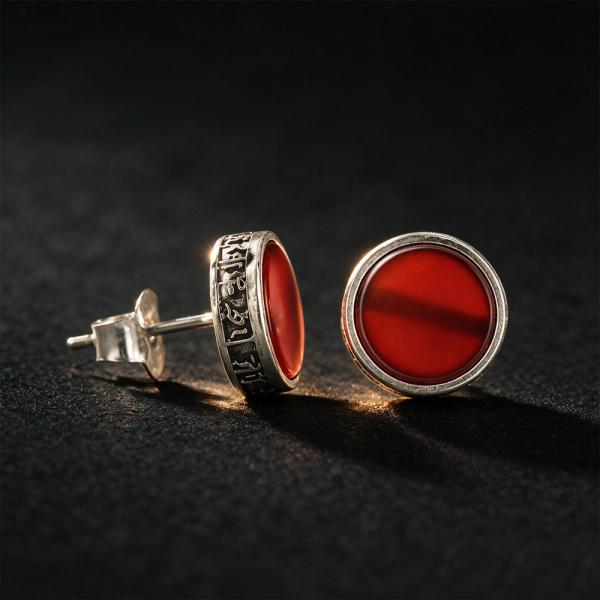
Tibetan letters already set straight strokes against curves, and in geometric treatment the curves are pulled straight and the strokes squared off until a line of syllables looks like a row of buildings. A stud is only so large, and all nine would smear into one mass, so a few are taken and the rest left empty, with the spacing of the group carrying the rhythm. After that treatment the syllable is still a syllable and no longer a syllable, which sounds convoluted until you see the picture. The empty space sits around the letters rather than in the middle, on the same principle as a seal.
Studs come in pairs and should mirror each other. If the lettering faces the same way on both, one will sit right and the other upside down, a detail that is hard to see in a photograph. The thickness should match too: one heavy and one light is felt in the hand even when nobody else can see it. The seat of the stud is made thin, because a thick one stands away from the lobe, and light cannot reach the side that lifts.
Studs are small enough to press behind the ear in your sleep, and a night of that leaves it sore. Take them out before washing your hair, since shampoo dulls silver. Keep the pair together rather than separating them; a single stud is more or less a write-off. Silver posts darken with wear, which is oxidation rather than dirt, and a rub brings them back.