


Menu
By theme
By theme

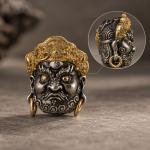
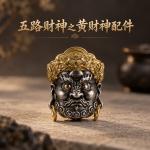
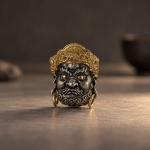

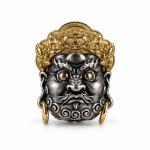
{{ variable.name }} : {{ variable.values[selectedVariantsIndex[variable_index]].name }}
Quantity:
Yellow Jambhala is one of the five Jambhalas, named for the yellow of his skin. He carries two markers: a wish-fulfilling jewel in the right hand and a jewel-spitting mongoose held in the left. What pours from the mongoose's mouth in Tibetan painting is a stream of mani jewels, coming out in strings. Identify the figure by those two objects; the face matters less. The five are yellow, white, red, green and black, each with its own office, and Yellow Jambhala sits at the centre.
As a bracelet component it usually goes in one of two places: below the guru bead as a dangling charm, or between main beads as a spacer. Hung as a charm, the back should be flat so it does not press on the skin; used as a spacer, the hole must be true, since a slight tilt twists the whole string. The two uses ask different things of the piece, so decide which you want before buying. As a spacer, one is enough: two begin to take the place of the main beads. The inside of the hole should be polished, because a rough channel abrades the cord, and a cord that breaks inside is the worst kind of trouble. A true hole is what makes a string hang straight.
Relief on a small piece forces hard choices. The belly of the deity is a broad curve and easy enough; the mongoose's tail is fine and curls over the wrist, and that is where definition goes first. Pressed shallow, the tail becomes a single line; pressed deep, mongoose and hand fuse and you cannot tell one from the other. If that passage works, the piece stands. On a component this small the depth available is limited, and past a certain point the back begins to bulge.
The phrase 'attracting wealth' needs some care. In Tibetan Buddhism Yellow Jambhala stands for merit, not a machine that pays out on request. Folk custom ties him to fortune, and that is a folk use, a way of settling the mind. Do not buy with a bargain in mind: it looks good, it feels reassuring, and that is enough. Some people simply like the stout little figure with no thought of money at all, which is the easiest way to wear him.
When assembling, leave some play in the bail below the guru bead; fixed too tightly, the charm will not turn with the wrist and hangs permanently askew. Silver worn with seed beads rubs against them, and in time the contact faces brighten, which cannot be avoided. Store it separately when it is off, and do not put it in a bag with bodhi seeds, which are hard where silver is soft. A bracelet with several silver pieces gains weight and hangs lower, so heft it in the hand while you are planning the arrangement.