


Menu
By theme
By theme



{{ variable.name }} : {{ variable.values[selectedVariantsIndex[variable_index]].name }}
Quantity:
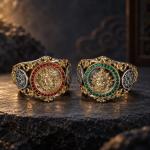
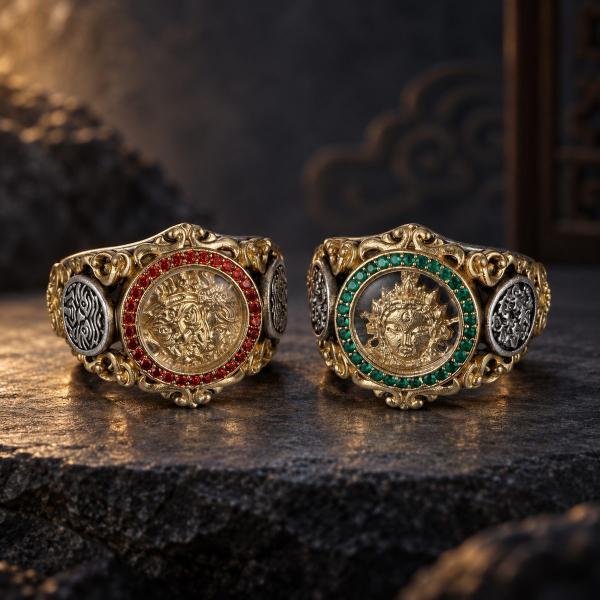
Zhaji Lhamo is the protector deity of Zhaji temple in Lhasa, female in form and heavily visited, with people seeking fortune queueing out of the door. Her usual image has a dark face, glaring eyes and the tongue extended, with a garland of skulls at the neck. She looks fierce, and most Tibetan protectors take that approach: the ferocity is aimed at harmful spirits, not at worshippers. Several versions of her origin circulate and they do not agree. Visitors often bring a bottle of liquor, a habit rare at other temples on the plateau.
Green Tara is the principal figure among the twenty-one Taras, green in body, right leg extended and left leg folded. The extended leg has a meaning: she is ready to rise and help without waiting to be asked. Her pose is fixed in thangka painting, one hand in a mudra and the other holding an utpala flower whose stem grows up along the arm and opens at the ear. Tara's green is ground from mineral in thangka work, and a shade either way changes her whole character. Her right hand forms the varada mudra with the palm turned out, a gesture easy to pick out in an image.
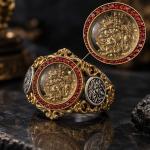
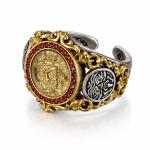
The difficulty with an engraved open ring is joining the face to the band. The face is a disc and the band is a curve, and a pattern running from one to the other has to change its spacing with the curvature, or it crowds into a knot at the side. The opening is usually left on the palm side, where it cannot be seen and is less likely to catch on anything. The sides of an engraved ring are where work is most often skimped: finish the front, turn it sideways and only a few coarse lines remain.
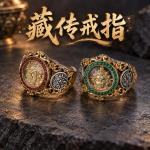
Set side by side, the two versions differ sharply in mood. Zhaji Lhamo is fierce and carries a sense of holding a room; Green Tara is quiet, eyes lowered, and suits daily wear. Which to choose depends on the company you want, and nobody can decide that for you. Both are common subjects in Tibetan work, and anyone who knows them will recognise them at once.
Do not keep bending an open ring; silver will not take repeated flexing. Which hand you wear it on is a matter of habit, and an open style needs adjusting once, not daily squeezing. Dust gathers in the engraved recesses, so go over them with a soft brush following the pattern, and never a toothpick. Silver wears fastest at the base of the finger, and that band brightens with time, a fate shared by every silver ring. Engraved silver dislikes hard contact: worn on the same wrist as a watch, the case will flatten the pattern.