


Menu
By theme
By theme






{{ variable.name }} : {{ variable.values[selectedVariantsIndex[variable_index]].name }}
Quantity:
In Tibetan country the nine-grid bagua plaque is something you carry, not something you set on an altar. At its centre is a three-by-three grid holding the numbers one to nine in the order of the Luoshu square; around that runs a ring of trigrams, and beyond them often the twelve animals of the cycle. Herders wore it at the belt, traders sewed it inside a coat lapel. What they wanted was not decoration but a bearing — something that told you where you stood wherever you went. Strictly speaking the object comes out of the Tibetan traditions of calendrical and divinatory calculation: it began as a tool for working out direction and choosing days, and only later became a plaque to wear, which is why it has no face on it, only signs.
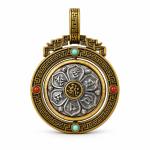
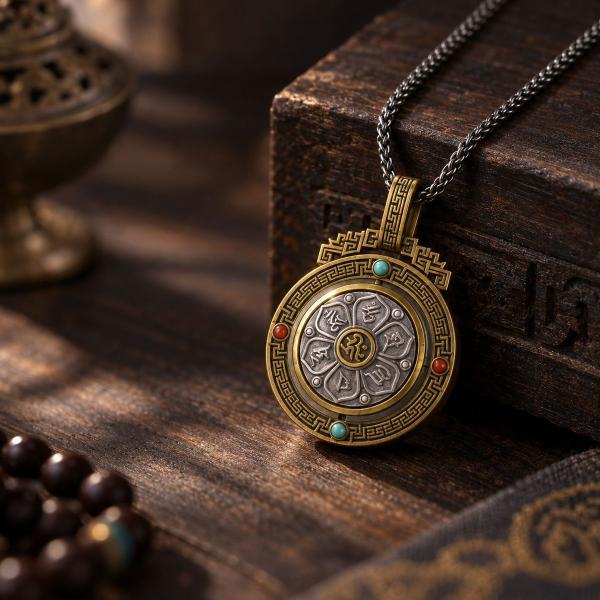
This one adds the six-syllable mantra to the face. Om mani padme hum, the heart mantra of Avalokiteshvara, the line most widely recited in Tibetan country. Carved into the plaque, it keeps the recitation about your person; glance down when your attention wanders and it serves as a reminder. Six characters in a row: the spacing has to be even and the cuts the same depth, because half a hair's difference in the casting shows the moment the piece is polished. The six syllables are a transliteration of Sanskrit and are not broken down word by word.
The spinning is the other piece of thinking here. Face and base are made separately, so a touch of the fingertip sets it turning, with a little resistance in it rather than a loose, idle spin. When your hands have nothing to do you turn it once or twice; the motion is close to a prayer wheel, and it gives the hand somewhere to rest. Tibetan practice runs clockwise — circumambulation, stupas, all of it — so you turn the plaque the same way. Turning it the other way does no harm, it simply is not the habit. Over time the fingertip polishes a small, warm patch into the silver. The back is plain, so it does not show through clothing and does not dig in.
The silver face is antiqued: recesses kept dark, raised areas brought up, which is what makes the pattern stand. Worn long enough it dulls of its own accord, and the cuts of the grid become clearer rather than less. A dark cord suits it — oxblood, ink black — pale colours cannot carry the weight of the plaque. Besides wearing it, people hang it in a car or on a bag. In a car, do not use too long a cord; under braking it will swing into the glass. Choose cotton over nylon for a dark cord: nylon slips and the knot works loose.
Dust in the pivot makes it stiff after a while. Pinch both faces in a soft cloth and turn it a few times and the grit comes out. In summer, with more sweat, wipe it with a soft cloth before putting it away, and do not throw it in a bag with your keys — cut edges suffer most from hard objects. The darkening on the face is applied, not dirt: it will not polish off, and it should not.