


Menu
By theme
By theme

{{ variable.name }} : {{ variable.values[selectedVariantsIndex[variable_index]].name }}
Quantity:
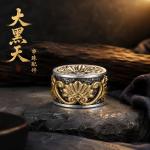
This figure is not popular in China proper, but in Japan he is one of the Seven Lucky Gods, Daikokuten, carrying a sack and a wooden mallet and looking a good deal milder than his Tibetan counterpart. One name, two faces, depending on where it travelled. In the Tibetan line he is a protector, Mahakala in Sanskrit, with three eyes, a wrathful expression and a skull crown; the six-armed form is the best known, and in some traditions he also carries a wealth god's role. Chinese shops occasionally have an image of him, usually in a corner, and few customers recognise it.
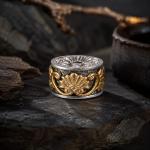
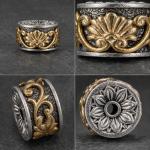
Made into a bracelet charm, the scale has to come down. Shrink a full figure to the size of a knuckle and the features smear into one mass, so only the head and the attributes in the hands are kept, and the rest is left open. Silver has a low melting point and casts detail more clearly than bronze, so small things — the teeth, the edge of the crown — survive. In the six-armed version each hand holds something different; at this size they can only suggest it.
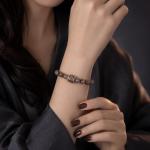
The point of the piece is to sit beside the main beads as a side charm. One bright point in a strand is enough; more than that and it turns busy. Stringing has its rules. Silver is heavier than wooden beads, and too fine a cord will wear through at the hole, so use a double strand, or elastic one size thicker. The hole edge is where the cord rubs; a soft cord furs with use, and once it furs, change it — do not wear it out of stubbornness. The charm's position also sets the balance of the strand: set off-centre, it will keep rotating to one side and feel wrong on the wrist. Tuck the knot inside the hole rather than leaving it out, where it looks like a small tail. Choose clear elastic; white thread shows up against dark beads.
The beads around it should go dark. Coconut shell, dark sandalwood, well-aged bodhi all hold it: the silver's white is pressed down and all you see is one bright block moving on the inside of the wrist. With warm stones like South Red agate or beeswax amber the contrast jumps, which is a matter of taste. A grey-blue braided cord works too; cool colours set off silver with the least effort. If the main beads are too large, the charm shrinks into a lump.
Some people wear it on its own as a small pendant on a fine cord, landing at the centre of the collarbone — cleaner than threading it among beads. Silver dislikes sweat: wipe it after wearing in summer, and if it blackens use a silver cloth. Do not soak it in silver dip; it comes out chalky white and the aged quality is gone. It does not need polishing every day — a little darkness actually holds its own against dark beads.