


Menu
By theme
By theme

{{ variable.name }} : {{ variable.values[selectedVariantsIndex[variable_index]].name }}
Quantity:
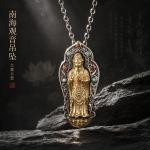
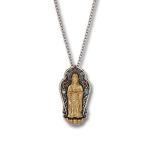
Guanyin was originally male in China; from the Tang and Song onwards the image gradually turned female, and the dress softened with it. The South Sea type is usually standing on water, a willow sprig in a vase, which carries the idea of dew scattered everywhere. "South Sea Guanyin" is a folk name rather than a scriptural one, and what it stresses is the hearing of cries and the saving of the suffering — the same kind of later, image-based naming as "Water Moon" or "White Robe".
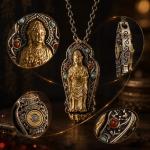
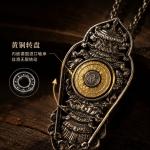
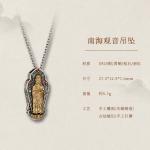
This is a pendant only, without a chain. The setting is where the cost sits: the bezel is kept low so the stone lies against the silver instead of standing proud, which cuts down the chances of knocking it day to day. Setting work is judged in two places — whether the silver around the stone has furred at the edge, and whether the seam between stone and metal is even. An uneven seam shows as a black line under light and looks like dirt from a distance. If the claws are exposed, check that all four are the same length. The bezel has to be pressed down hard; if it is not, the stone will work loose.
The face decides whether a piece like this works. A hair's difference in the depth of the eyes and brows and the whole face collapses. The brows are low, the smile held in; smile too widely and it turns saccharine. The cheek is the brightest part of the silver, and the light landing there is what makes the face alive. The area behind is kept darker so there is depth front to back, and the front does not read flat. The line of the crown must not break; broken, it looks like a chip out of the edge. That curve is the hardest thing here — two degrees out and the eyes are closed.
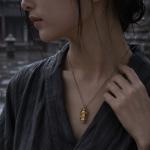
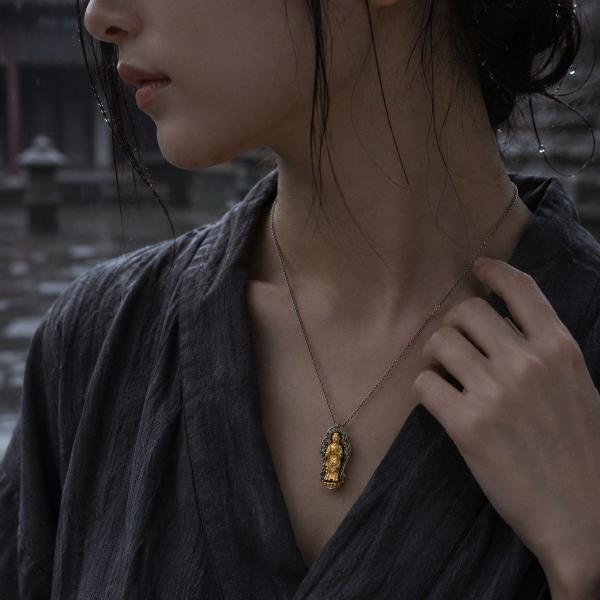
A pendant on its own has one convenience: anyone who already has a chain does not need to buy another. The loop is made slightly larger than usual so most clasps will pass through it, and you can swap it about without hunting for a needle. A plain silver chain is safest, though a braided cord works too — put the colour on deep blue or ink green and Guanyin's white comes forward. Do not go too thick with the chain; thick, it overwhelms the quiet.
For a mother or an older relative this kind of piece is hard to get wrong. No one needs the symbolism explained; they recognise it themselves. If you do add a card, two words are enough — peace, safety — keep it short. An inlaid stone dislikes knocks: take it off for housework or moving furniture, and run the silver cloth around the setting rather than over it, so you do not scratch the metal at the stone's edge. Store it in its own small bag; a stone face suffers most in a pile. The clasp is the first thing to fail, and replacing a clasp costs less than replacing a chain.