


Menu
By theme
By theme

{{ variable.name }} : {{ variable.values[selectedVariantsIndex[variable_index]].name }}
Quantity:
Charm coins never circulated. They were cast for warding off evil, for blessings, for protection, which left the format much freer than circulating coinage — the largest are as big as a palm. The mountain ghost coin is one branch of these: one face carries a talismanic script and the figure of the mountain ghost, the other usually a thunder order, a bagua, or characters such as "thunderbolt kills ghosts". Large numbers were cast from the Song onwards, and people hung them on curtain hooks or kept them at the bottom of a chest. The name of the type, yasheng qian, comes from yasheng — sheng being the malign, and the coin pressing it down.
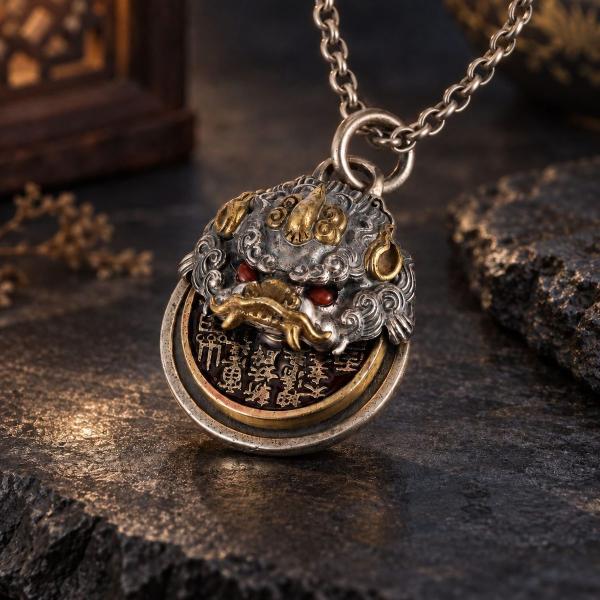
One thing should be clear: the mountain ghost on a charm coin is not the mountain ghost of Qu Yuan's "Nine Songs", the one draped in climbing fig and sash of dodder. The first is a figure from the Taoist talisman system — blue face, holding an object, treading on demons — a sign used in ritual work; the second is a deity in the sacrificial songs of Chu. The names collide, the origins go their separate ways, and it is best not to mix them. The strokes of the talismanic script carry turns, and the endings flick upward, in the manner of seal script.
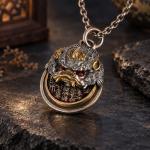
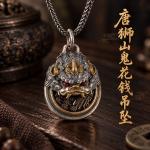
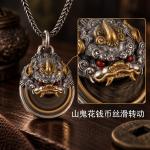
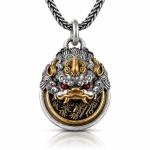
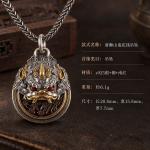
The Tang lion means the stone lion of the Tang dynasty: head high, mouth open, chest full, mane curled into snail-shell knots, forelegs braced straight. This pendant puts the lion's head at the front, with the round mountain ghost coin set behind as a ground, one in front of the other, and the teeth in the lion's mouth offset from the hole in the coin so that the front does not read as a black void. Four teeth show; more looks like a grin, fewer looks toothless. The mane's coils are arranged in three rings, larger towards the outside. The head is given a thick base, which is what lets its edge hold the curve of the round plaque.
The talismanic script is an archaising hand: the strokes carry the wave and pause of old calligraphy, not freehand curves. Not being able to read all of it is normal — people in the trade mostly recognise a few common ones. The same script, cut by different hands, ends its strokes differently, and that is what a connoisseur looks at. Here it is pattern, not a ritual object; anyone with an altar at home should not substitute it for what belongs there. The round edge is chamfered so it does not cut the hand. The plaque at the back is slightly smaller than the lion's head, so only a rim of it shows from the front.
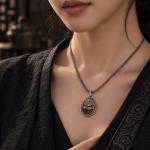
A dark cord at chest length; red suits it too. The silver is antiqued, with black kept in the hollows so the script can be read. When polishing, avoid the cuts and do not clean the black away — it is the ground that makes the characters stand. Some people use it as a paperweight; others hang it on a bag.