


Menu
By theme
By theme



{{ variable.name }} : {{ variable.values[selectedVariantsIndex[variable_index]].name }}
Quantity:
The vajra began as an Indian weapon and later became a Buddhist ritual implement; in Sanskrit it is vajra, whose root sense is thunderbolt and diamond — hardness, and the power to break. Chinese vajras are usually thick at both ends and narrow in the middle, the heads divided into prongs: three, five, nine, with different meanings. Single-pronged ones are rare and mostly belong to esoteric ritual. The number of prongs is discussed in the ritual texts: three for the three mysteries, five for the five wisdoms. The narrow waist and flared ends are a proportion inherited from the weapon.
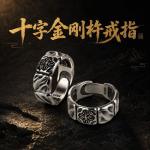
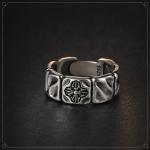
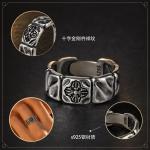
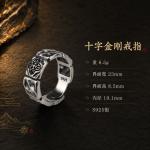
The cross vajra is also called the karma-vajra: two vajras crossed, four heads facing the four directions. It stands for Buddha-wisdom filling every direction, and for the unmoving and firm. In making, the four heads must be the same size and the crossing exactly centred; off a little and the whole cross leans, and set on a flat surface you can see it rock. All four heads have the same number of prongs and face the same way, simply rotated ninety degrees. The ring at the crossing is where air is most likely to be trapped in casting.
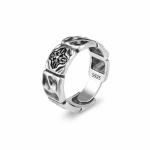
As a ring, the vajra's three dimensions can only be flattened onto the band. The raised prongs need rounding: too sharp and they catch knitwear, and rub the back of the hand. The bright finish stays on the spines, the grooves kept dark, so the light shifts as the finger turns and the form still stands. The thing to fear with a piece like this is over-polishing: once the shine is even, the grooves between the prongs disappear. The dark in the grooves does not need cleaning — it is the shadow that lifts the prongs. Four heads crowded onto a knuckle will press if made large. The band is about as wide as the knuckle; wider and it pushes against the next finger.
The opening adjusts, so the size needn't be measured exactly: it goes on an index or middle finger. When adjusting, hold both sides of the band and close it slowly — do not squeeze the heads, which are hollow and will deform under pressure. The opening is already under stress, so do not lift heavy things or open bottles with it. An open ring loosens with long wear; a squeeze brings it back.
Tibetan-style pieces value weight, and this one is not heavy — it does not tire the hand for everyday wear. It suits a Tibetan-style braided bracelet or plain clothing, and does not look odd with formal dress. When the silver dulls, a polish is enough; leave the black in the hollows and the layering of the vajra becomes clearer. Tibetan braiding is usually cotton; nylon is shiny and does not sit well with silver.