


Menu
By theme
By theme


{{ variable.name }} : {{ variable.values[selectedVariantsIndex[variable_index]].name }}
Quantity:
Om, ma, ni, pad, me, hum — six syllables, the heart mantra of Avalokiteshvara. Mani is the jewel; padme is the lotus. Together they are usually read as "the jewel in the lotus", though there are other readings and the schools do not entirely agree. Recitation of the line is enormously common in Tibetan country: one turn of the prayer wheel in an old person's hand is one recitation. Each syllable has its own significance, and the line is not unpicked into meanings as you say it. Tibetan and Chinese pronunciation differ, since the transmissions differ, and neither side should call the other wrong. Once it is familiar the six syllables turn by themselves, and you stop counting.
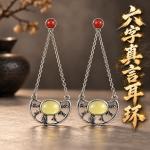
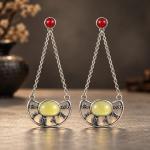
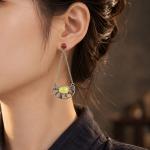
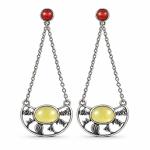
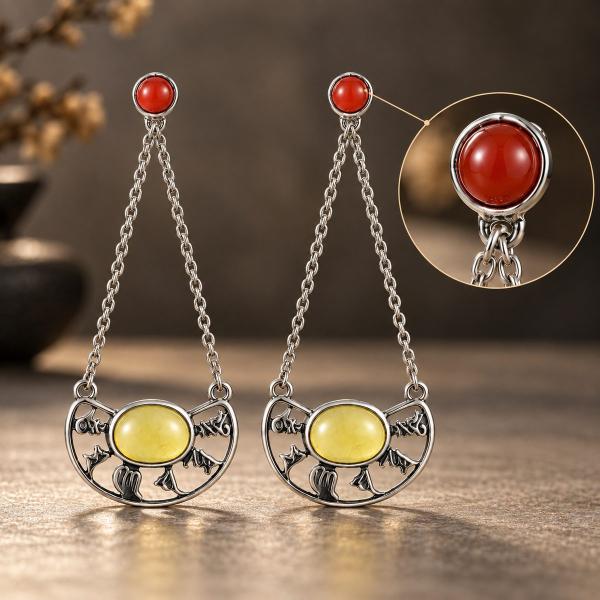
The crescent is rarely used on its own in Chinese pattern; it usually appears with stars and clouds, in the "star and moon" subject. On an earring it works: the arc hangs down and follows the line of the lobe. The two ends of the curve sit at different heights, and the lower point drops to about the jaw, so it is the first thing to move when you turn your head. Both ends taper to a point, and the points need rounding — too sharp and they catch hair.
The advantage of a drop is that it moves. Standing still it lies against the neck; walking brings out the swing, and the swing is what gives the six syllables their weight. Too much swing is no good either — too long or too heavy and it strikes the jaw. The length here is kept within a range that does not touch the face, and the arc of the swing is a small one. At the moment you stop, it is still moving.
The six syllables follow the curve of the crescent. Each character sits at a different angle to the arc and has to be checked individually in the casting. Whether the spacing is even cannot be judged from the front; you tilt it to the light and check that the relief is consistent. The recesses are left dark so the characters float on the curved surface. Characters on a curve are harder to cast than on a flat face, and the mould has to be made in two halves.
It does not ask much of clothing: a plain high neck or a round neck, either. With the hair down only half shows; with it up the whole crescent does. Worn as a pair they make a complete crescent; a single one reads as a hook, which also works. Hooks loosen with long wear — pinch the tail of the hook and it tightens. Silver earrings dislike sweat and water: take them off before a shower, dry the hooks before putting them back. If they blacken, pinch them in a silver cloth; do not force the hook, because once that curve deforms it is awkward to wear.