


Menu
By theme
By theme






{{ variable.name }} : {{ variable.values[selectedVariantsIndex[variable_index]].name }}
Quantity:
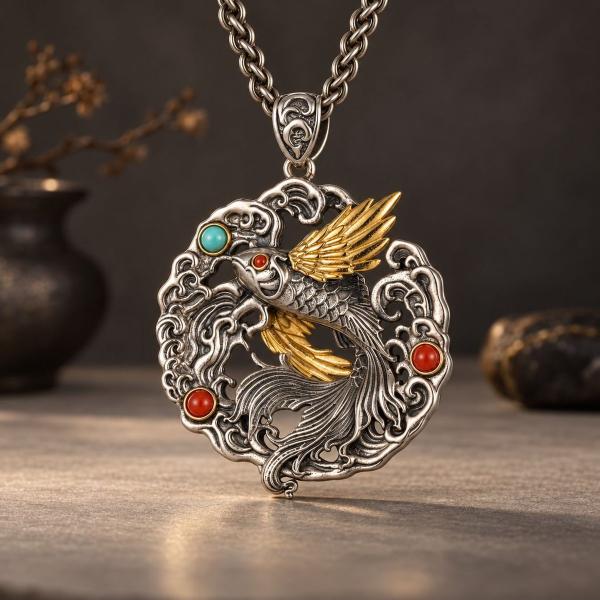
The wenyao fish is recorded in the "Western Mountains" chapter of the Classic of Mountains and Seas. In the water below Mount Taiqi there is a fish shaped like a carp, with a fish's body and bird's wings, blue-green markings, a white head and a red beak; it travels the Western Sea, swims in the Eastern Sea, flies by night, and its call is like that of the luan bird. When it appears, the whole realm has a great harvest — the ancients took its appearance as a sign of a plentiful year. The passage is short and dense; almost every phrase in it could be turned into a form. White head, red beak, blue-green markings: the old record is that precise about colour. Most of the strange beasts in the Classic are assembled from parts, and fish body with bird wings is the commonest assembly.
The hard part is sewing the two together. The fish body has to run smooth, the wings have to open, and the join must not look applied. Here the wings grow out of the dorsal fin position, the wing bones following the line of the scales and only separating halfway along. From a distance it is a fish; close up you notice two extra things on its back. The wing membrane has to be even in thickness — thin and it goes translucent, thick and it goes dead. The wing root has to press into the fish's back; if it does not, they look like two sheets of paper stuck in.
On the silver, scales and wings are treated separately. The scales are low relief, one over the next; pressed too deep they look clumsy. The wings are thin sheet with sharp edges — sharp enough to catch a line of light. The action of flying by night comes from the lift of the tail fin and the raise of the wing tips: pull in two directions and the fish has the look of leaving the water. The tips must taper to points; blunt, it cannot fly. The scales run from behind the gills to the tail stock, each row smaller than the last.
"When it appears, the whole realm has a great harvest" is what the ancients said; it is written here as the cultural source, not as a promise. Most people who buy it like the passage, or like the improbable combination of fish body and bird wings. Whether it is reasonable does not matter much; whether it looks right does. This kind of note is common in old books: it records what people at the time thought.
A dark cord — blue or ink green both bring out the silver's white. Chest length, and a cotton or linen shirt suits it best. Silver oxidises and the scale recesses go black first, which happens to be the shadow the scales ought to have; do not clean it out too thoroughly. A blue cord with a silver fish is the colour nearest the sea. The tail is set slightly out of line with the body, so it reads as moving even at rest.