


Menu
By theme
By theme

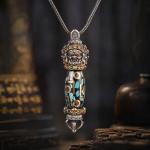


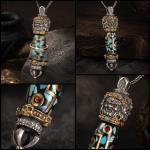
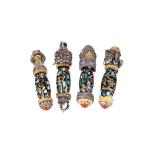
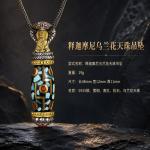

{{ variable.name }} : {{ variable.values[selectedVariantsIndex[variable_index]].name }}
Quantity:
In Tibetan these beads are called dzi, and the patterns on them are sorted by number of eyes and by their lines — one eye, two eyes, lotus, treasure vase, each with a name of its own. Wu lan hua is a trade term for a group of patterns with strong black-and-white contrast, white lines coiling into petal shapes on a black ground. The names were never standardised, and the same bead may be called two different things in the south and the north. Most of this classification grew out of the way dealers and collectors talk, so it is worth treating as a working vocabulary rather than as a classical nomenclature — pleasant to use, but not something to build an argument on.
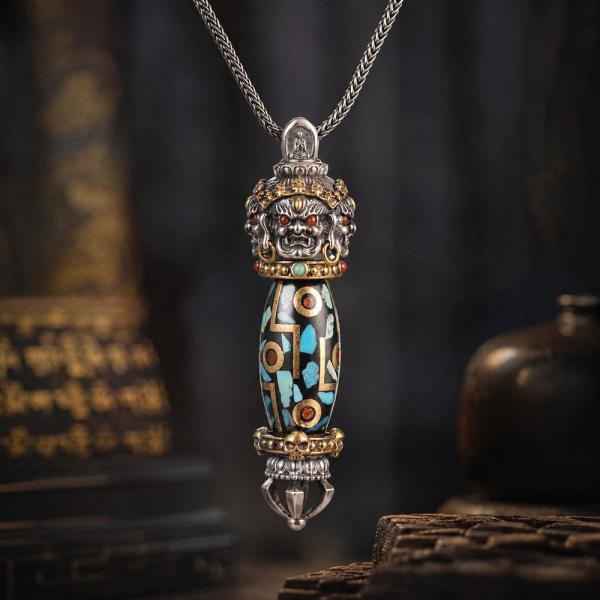
There are four designs in this group, each going its own way. The small dragon-snake combines a zodiac animal with a spirit creature, taking the snake's form and adding a trace of dragon. Mahakala is a Tibetan protector deity, wrathful in aspect, and the face is meant to be fierce. Ganesha comes from India, long trunk and large ears, and is honoured in Tibetan regions as well. Manjushri stands for wisdom, and the sword in his hand is understood to cut through affliction. Placed side by side, the four are usually chosen by affinity rather than completeness. People in business tend towards Mahakala; scholars lean to Manjushri. That choice has nothing to do with the bead and everything to do with the person.
The silver mount tests the hand more than the pattern does. The body of the bead is usually agate, with a hardness of about six and a half to seven, harder than silver, so a little too much force on the bezel and it chips at the edge. The rim therefore has to sit close without biting, and the claws have to hold without leaving a mark. Backs are often left plain, or opened with a small window that lets the bead breathe and saves material. The four claws must be evenly placed: off by a little and the bead sits crooked, the pattern reads as diagonal from the front, and after a few months of wear it will bother you every time you look at it.
This sort of thing is best worn against the skin; a layer of cloth in between takes the point out of it. Agate dislikes heat and knocks, so take it off for cooking or shifting furniture, and don't carry it in the same pocket as a key ring. Sweat collects in the gaps of the mount. Once a month, go over it with a soft brush and clean water; the black in the crevices is the oxidised finish and there is no need to scrub it white. Old beads have weathering lines of uneven depth with rounded edges, while new artificial ageing runs regular, as though it had been carved in.
Don't pair it with too heavy a chain. The bead has volume of its own, and a thick chain drags the whole piece down until it looks like a lock plate hung on a string. A plain chain just over a millimetre thick, finishing two fingers below the collarbone, puts the bead above the breastbone, where it taps lightly against clothing as you walk and makes no sound at all. A round neck in summer leaves the bead outside; a turtleneck in winter takes it in, and then it is simply a private object kept against the skin.