


Menu
By theme
By theme



{{ variable.name }} : {{ variable.values[selectedVariantsIndex[variable_index]].name }}
Quantity:
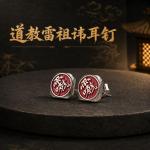
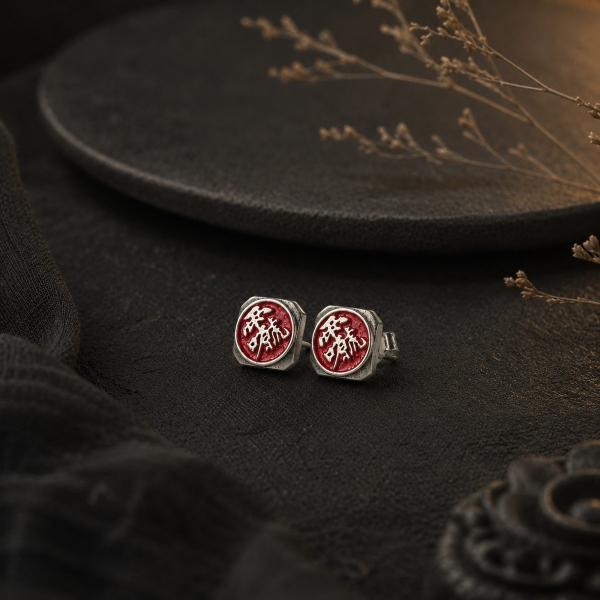
Leizu is the Heavenly Worthy of Universal Transformation of Thunder Sound of the Nine Heavens, the chief deity of the Daoist thunder department. Talismans do not write a god's name directly; a hui — a secret written form — stands in its place. The hui character is built by stacking, abbreviating and coiling the name into a talismanic shape, meant only for those who recognise it. Thunder ritual manuals contain many versions, and the stroke counts differ, because different lineages transmitted their own. Check one against a dictionary and it will mostly fail to match. That is not a mistake in the carving. There was never meant to be one standard answer.
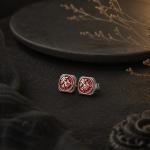
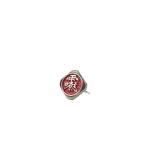
On this stud the hui character is filled with enamel. Fired enamel is a glassy layer, deep in colour and without a cheap glare, and against the cool white of silver the outline of the character reads more clearly than it would in bare metal. Enamel goes into a high-temperature kiln, which softens the silver, so the base has to be made thicker; a thin base warps in the firing and the lettering goes crooked with it. One piece may go into the kiln several times, and each firing can crack it. Yields are low, and that is why enamel work costs more than plain silver of the same weight.
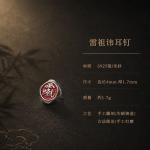
A stud gives limited area, and a hui character is dense, so the strokes are packed in. Judging the work comes down to three things: is the lettering crisp, is the enamel level, has colour spilled over the edge of the channel. Filled too shallow, it wears down after a while and the character blurs. Filled too full, it bulges in the firing and small bubbles rise on the surface. The edge of the channel should stand up; seen at an angle there is a fine rim, which is the wall of the silver base. Without that wall the enamel has nothing to grip.
On the earlobe, face outward, what other people see is a character they cannot read, and you know what it is. A subject that doesn't announce itself wears better than a plaque with one big character cut into it. Enamel chips, so take care changing clothes or putting on a helmet; a chipped corner cannot be filled in, and the whole piece has to be refired. Post thickness matters too. Too thick and the piercing aches by the end of the day; too thin and the stud sags forward on the lobe.
Silver oxidises and enamel does not. When the studs go dark, take a silver cloth to the silver parts, but don't drop the whole piece into silver dip — the liquid seeps into the seam between enamel and silver, and in time it lifts the fill. Store them in their own small bag. Mixed into a box with other earrings, enamel surfaces pick up cloudy scratches faster than anything else. If the clouding is shallow, a little toothpaste worked in circles with a fingertip will ease it. Deep, and there is nothing to be done.