


Menu
By theme
By theme






{{ variable.name }} : {{ variable.values[selectedVariantsIndex[variable_index]].name }}
Quantity:
The Golden Light Spell is one of the eight great Daoist spells and is recited in both morning and evening liturgy. It opens with lines about the dark origin of heaven and earth, the root of all qi, cultivation through countless kalpas, and the confirming of one's spiritual power. The whole text is short. Folk practice copied it onto yellow paper for the door, and it has also been cut into plaques to carry. It sits early in the liturgy and works along the lines of protection rather than being a private secret spell; it is recited daily in temples, and versions are broadly consistent from place to place. It needn't be spoken aloud. Running through it inwardly counts.
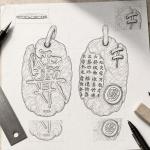
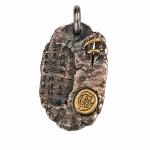
The whole text won't fit. A pendant is only so big, and each character has to stand on its own; cram the full text in and it becomes a blur. There are two common approaches: take the opening lines, or cut just the three characters of the title. Lines are set vertically, top to bottom, with even spacing. If only the title is cut, the characters can be larger with the strokes opening out, and then the plaque needs a border to hold it; soften the border and the whole face goes empty. Either way, look at the depth of the cuts. Shallow lettering flattens within six months. Deep lettering has a fine standing wall at the edge, visible in raking light.
An S925 sheet forms the base, engraved on the face and plain at the back. Too thin a sheet warps, especially on a long rectangular plaque, curling at the ends so it won't lie flat against the chest. A thick sheet is harder to cut but takes a deeper letter and stands up to several rounds of polishing. The bottom of an engraved groove should be left slightly rough; polished smooth, it reflects, and the character looks as though it is floating above the surface. A plain back is not the easy option, either. Pits and scratches on a blank face are more obvious than lettering would be.
These plaques are mostly worn close, tucked inside a collar, and not shown to anyone. Some hang them in a car below the mirror, and then cord length matters: under braking the plaque swings forward, and a long cord lets it strike the glass. For a car, choose a thicker piece, because a thin plaque won't take daily swinging. Use a cotton cord. Nylon is slippery, knots work loose, and when a knot opens the plaque is gone for good. Change the cord every six months, and check the hole for fraying while you are at it.
Dust in the lettering is the real annoyance. Once the silver darkens, black and grey mix in the grooves and it looks as though the engraving has failed. Don't clean with silver dip; the liquid sits in the lettering and dries to a white ring. Warm water with neutral soap, a soft brush along the strokes, and dry immediately afterwards. Where a cloth won't reach, wrap a toothpick in thin cloth and run it along the groove rather than scraping across it. The plaque doesn't need frequent washing — once or twice a year is enough, and wash it often and the lettering rounds off.