


Menu
By theme
By theme





{{ variable.name }} : {{ variable.values[selectedVariantsIndex[variable_index]].name }}
Quantity:
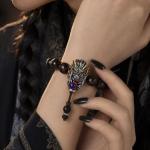
A three-hole bead is the turning component on a bracelet: three holes set in a T, one cord entering from above, two leaving at the sides, with a Buddha head below or a knot to finish. On this one the qilin's head is tilted, not facing straight ahead but angled to one side. It feels awkward in the hand. On the wrist you understand why. The wrist rotates inward of its own accord, so a full-face image would be hidden; angled a little, people standing at your side still see a face. Only someone who understands how a piece is actually worn would arrange it this way.
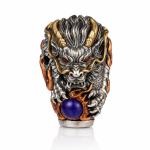
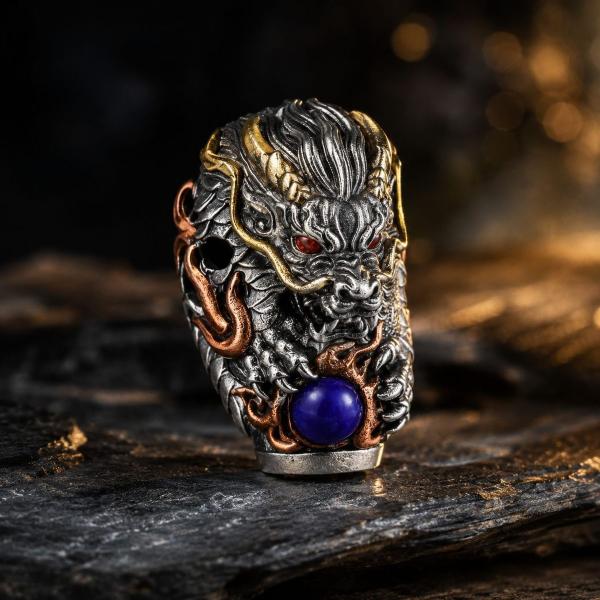
The qilin appears by the Han dynasty. In stone reliefs it is a horned, deer-like creature with a long body, not yet the busy design it later became. By the Ming and Qing it had settled into a dragon's head, deer's antlers, a body covered in scales, an ox tail and hooves. With the dragon, phoenix and turtle it forms the Four Spirits, written in the Book of Rites as lin, feng, gui and long. Of the four, only the qilin has no living original. It is an assembled beast, and yet the most popular of them, appearing before temples, along tomb avenues and in embroidery.
An S925 three-hole bead is heavier than wood, and strung on a bracelet it pulls the centre of gravity towards itself. With the balance off, the strand rotates on the wrist, and rotation loosens the cord. Place the silver piece towards the upper side, so that it rests against the wrist bone instead of hanging free. The hole edges must be rounded. Silver edges are sharp, and a cord running back and forth over them can wear through one strand in a few months. It goes without a sound, and you only find out when the beads scatter.
For pairing, a silver three-hole bead sits well with dark wooden beads, coconut shell or aged bodhi; against pale beads it looks top-heavy. The qilin's horns, whiskers and hooves are all raised, so keep the cord from pressing on them, because pressed long enough it will wear a groove. Use a multi-strand braided cord for the bracelet. Single-strand nylon is too slippery inside a silver hole and the knots open. Bead size should follow: the three-hole bead a size larger than the main beads is right, and much larger breaks the strand visually into two.
Worn for a long time, sweat collects between the scales, and the salt in it darkens the silver faster. Brush with a soft brush and clean water, dry it, then store. The qilin's mouth and the tips of its horns take knocks most often. Small dents can be left alone, since silver dents are shallow and read as wear rather than damage. A proper repair would mean annealing and recasting the whole piece, which isn't worth it. Change the cord once a year, and clean the grime out of the holes while you are about it. That grime is sweat and silver oxide; once hard it is like cement, so soak it in warm water for a while before brushing.