


Menu
By theme
By theme


{{ variable.name }} : {{ variable.values[selectedVariantsIndex[variable_index]].name }}
Quantity:
The story of Zhong Kui comes down from the Tang. Song dynasty notebooks record it clearly: the emperor Xuanzong, unwell, dreamed of a great ghost catching a small one, which named itself Zhong Kui, a candidate from Mount Zhongnan; the emperor woke cured and summoned Wu Daozi to paint the figure. Painting Zhong Kui then became a custom of the New Year — pasted on doors, hung in the main hall, and at the Dragon Boat festival as well. A figure from a dream, fixed first on paper and then on doors: over the centuries the face grew fiercer and the duties wider, until even the marrying off of his sister became a painting subject. In the paintings the brows grow more savage year by year, while the robe gets more and more elaborate.
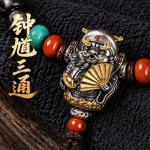
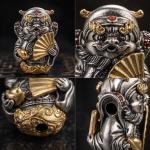
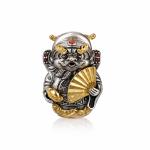
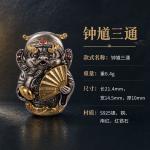
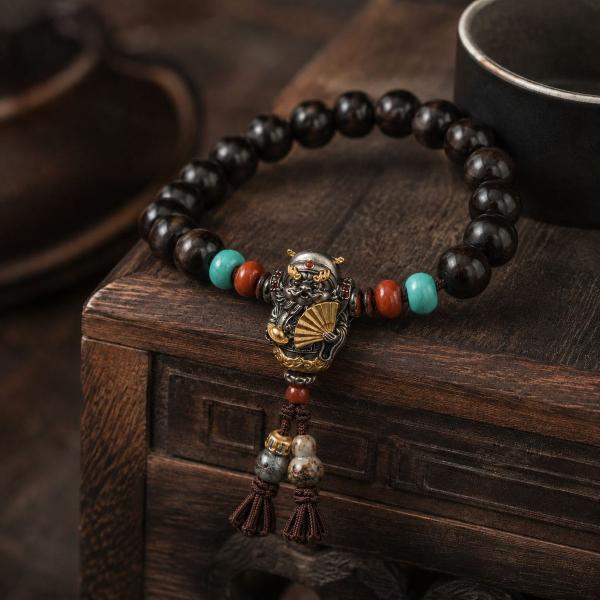
There are two sculptural approaches. One is the martial type: black face, curly beard, a sword in one hand and a ghost gripped in the other, robes flying. The other is the civil type: red robe, black gauze cap, dressed as a judge, with a few small demons in attendance. This one is made on a three-hole bead, where the face is small and the features can only be summarised in a few cuts — brow ridge pushed down, eye sockets cut deep, the beard carried by a handful of vertical grooves. One cut too many and it muddles; one too few and it stops being him. That measure is the whole difficulty.
In cast silver the deep recesses hold black, which serves as beard and brows, while the raised areas are polished bright for the forehead and cheekbones. That light and shade is not painted on. It comes out of the form itself, and the ferocity of the face shifts as the angle changes. Polish it too bright and the menace goes, leaving a stage actor; leave it slightly matte and it holds. Ageing worked into the eye sockets and the corners of the mouth is what brings the figure alive — darken those two and the face starts looking back at you.
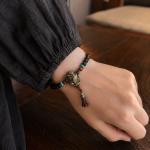
The three-hole bead sits above the wrist bone and shows whenever a cuff lifts, so it is the face of the whole strand. Zhong Kui's expression is fierce, and some people find it uncomfortable to look at every day; others want exactly that ferocity, for the sense that it holds something in check. Both are fair. With something you wear, your own eye is the only test that matters. Keep the spacer beads quiet: a fierce face surrounded by red and green looks trivial. Younger wearers should use a dark cord rather than gold thread.
The grooves of the beard are the hardest to clean. Dust collects, hardens into a crust, and picking at it with a needle scratches the silver. Soft brush and water, brushing along the grooves, then dry with cool air from a hairdryer. Store the piece in its own bag rather than with other metals, because the raised parts of a face are easily knocked flat, and once flat the expression is gone. If it is dropped, check the nose first; a flattened nose tip and the whole face falls apart. Don't be in a hurry to clean the dark out of the face. Clean it away and the ferocity goes with it.