


Menu
By theme
By theme





{{ variable.name }} : {{ variable.values[selectedVariantsIndex[variable_index]].name }}
Quantity:
The vajra came from India, where its prototype was the thunderbolt in Indra's hand. Buddhism took it for the sense of solid and indestructible, and in Tibetan it is dorje. The five prongs of a five-pronged vajra stand for the five buddhas of the directions, the central prong for the nature of the dharmadhatu, and the lotus seats at either end are the supports. It is usually paired with the bell: the vajra for method, the bell for wisdom, one hard and one soft, one in each hand during ritual. Made into a pendant on its own, what is taken is the hardness, and there is no need to read it through its liturgical use.
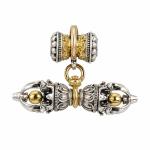
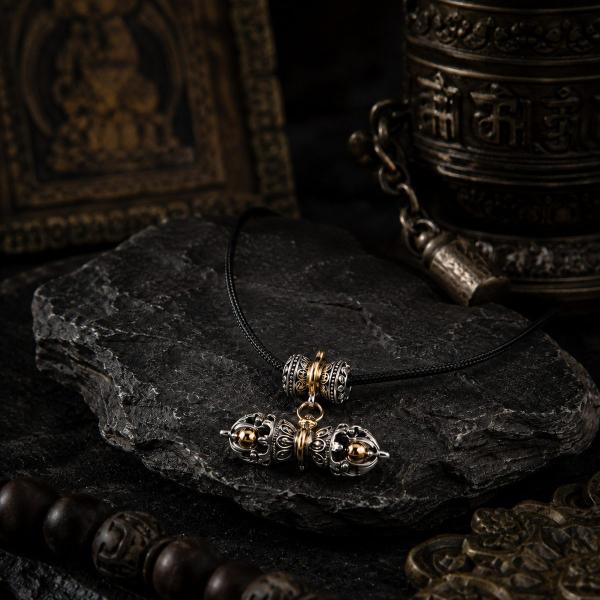
In form, the central prong tapers to a point at both ends, and the four outer prongs curve out from the lotus seat to enclose an arc. The spacing between prongs has to be even; seen from the side it is a flower opening symmetrically. The waist is the thinnest section and the place where casting most often fails — pull it from the mould at a bad angle and the break is at the waist. The prong tips are usually blunted rather than needle-sharp, to avoid injury and to avoid chipping. The petals on the lotus seat should overlap one over the next; out of order, the whole vajra looks coarse.
S925 has the ductility to bend four prongs into an even arc. Silver's white is cool, and after polishing the curved surfaces carry fine bright lines that move as you turn the piece. An oxidised finish darkens the gaps between the prongs, and the five-fold structure emerges, like five fingers closed together. Softness helps as well: a knock leaves a shallow dent rather than chipping a corner off. The drawback is that the dent stays, and polishing won't take it out.
Worn at the chest, some people point the tip up and some down. There is no fixed rule; it depends how the knot is tied. Don't use too fine a chain, because the vajra has volume and a fine chain won't carry it, so it hangs forward instead of lying flat. In summer with an open-collared shirt it shows, and the metal is briefly cold against skin; in winter, tucked inside, it sits closer. Don't wear it with a turtleneck, because the tip presses into the collar and by evening there is a bulge in the fabric. Keep the cord long enough as well; too short and the vajra sits on the throat and digs in when you speak.
The gaps between the prongs are the hardest part to wipe. A silver cloth won't go in, so use a soft brush with a little soapy water and dry at once, since water left in the gaps speeds oxidation. A silver vajra dislikes falls, and the joins between prongs are the weakest point; after a drop it will usually open there. Store it flat rather than hanging on a hook. Swinging widens the cord hole over time, and a wide hole lets the cord sit loose and the vajra hang crooked. Crooked isn't serious. A worn-through cord is. Pinch the knot and check it every so often.