


Menu
By theme
By theme






{{ variable.name }} : {{ variable.values[selectedVariantsIndex[variable_index]].name }}
Quantity:
The character in question, jian, is written with rain above and the components of gradual and ear below; broken apart in folk usage it reads as rain, gradually, ear. Duan Chengshi's Tang collection of strange tales has a line saying that people die and become ghosts, ghosts die and become jian, and ghosts are afraid of jian — which is why the character was written on doors in older times. That is a claim from a notebook of the marvellous, not formal ritual from either Buddhism or Daoism. Local gazetteers mention it now and then, and the writing was never standardised, with versions one stroke more or less in circulation. It is more accurate to read it as a folk marker than as a talisman.
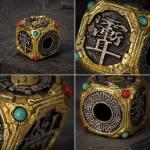
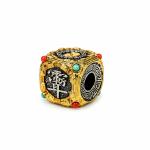
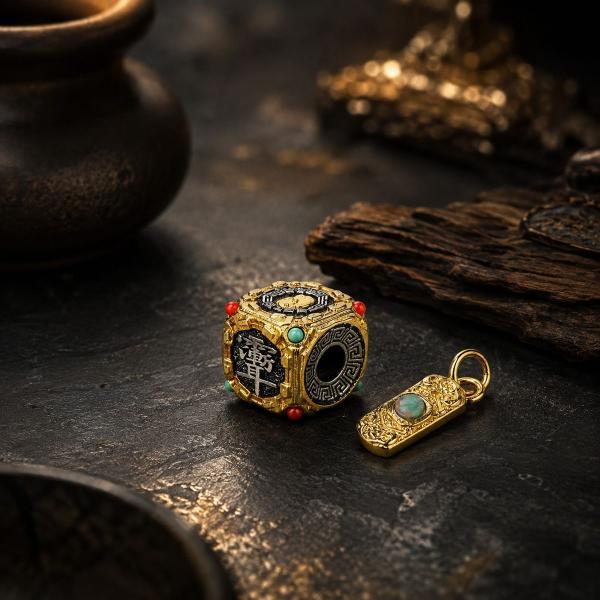
The square component comes in two shapes, one square and one rectangular. The four corners carry a slight raised edge, three characters are cut in relief vertically on the face, and the back is plain. A square plaque sits better in a strand than a round one because it won't turn, so the characters always face one way; a round plaque rolls on the cord and ends up sideways. The rectangular version suits a main strand as a dividing plaque. The square one is smaller and fits between spacers without taking up space. Watch the proportions of the rectangular one: too little difference between length and width and it looks neither square nor oblong.
The holes run through top and bottom, so on a main strand the piece is a small wall separating the sections in front and behind. Some people don't string it at all and hang it from a cord on a bag, or use it as a small pendant. The edges are right-angled, so swinging on a bag they knock against zips and keys, and a dent can't be repaired. Feel the four corners when choosing: rounded ones feel smooth, square ones scrape the hand and wear cloth as well. For a bag, use a leather cord — soft, and it abrades slowly.
On a silver square the edges are the difficulty. Casting always leaves a little burr at the corners, and each one has to be drawn down with a file. Take off too much and the corner collapses; too little and it is sharp enough to catch. The three relief characters on the face are raised and must be the same height; one high and one low and the whole plaque looks crooked. The plain back is in fact harder. Pits and scratches on a flat surface show more clearly than a pattern would.
Dust collects fastest in the angle between the lettering and the border. Wrap a toothpick in thin cloth, dip it in clean water and run it along the corner. Don't use a needle tip, which leaves a white line on the silver. Once the silver oxidises, the tops of the relief characters brighten first and the recesses darken first, and that contrast is correct. Don't soak the whole piece in dip for the sake of cleanliness: it comes out uniformly white, lettering and ground merge, and it looks worse than before. Pad the piece with soft cloth when storing, because the four corners are the most delicate part.