


Menu
By theme
By theme


{{ variable.name }} : {{ variable.values[selectedVariantsIndex[variable_index]].name }}
Quantity:
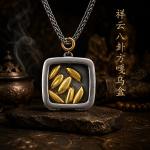
The gau box is an object carried on the person in Tibet — ga'u in Tibetan — a small box holding a buddha image, a mantra, a piece of a teacher's clothing or another sacred object, hung at the chest on a cord and covered with a cloth bag to save wear on clothing. Walking, the box lies against the body and makes no sound. Herding families heading far from home might leave other things behind, but not this one. It is a container first; good looks came later. What goes inside is each family's own business, and outsiders needn't ask.
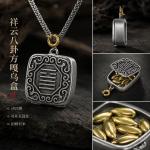
On this one the front carries the eight trigrams, with auspicious clouds around the edge. The trigrams are qian, kun, zhen, xun, kan, li, gen and dui, arranged in either the Former Heaven or the Later Heaven sequence, and folk pieces mostly use the Former Heaven. Square boxes are rarer than round ones, and the difficulty lies in the four corners: silver sheet buckles as it is bent round a corner, and hammering it flat thins it, so the corners end up a different thickness from the body. After polishing, the four corners shine while the middle goes dull, and it shows at a glance. The clouds must run around the border in one direction; reverse one and the whole ring loses its flow.
The box has a lid and a base with a tongue-and-groove fit. The lid should have a little resistance: too loose and it opens itself, too tight and it hurts the fingers without opening. Inside, a thin layer of cotton keeps the contents from rattling. The bagua on the lid is in relief and the raised lines must be the same height. The three horizontal lines of qian are the longest and the most likely to be pressed flat, and once flat the whole face is crooked. The wall shouldn't be too thick either. Thick means heavy, hanging at the neck, and by the end of the day the neck is tight. Leave depth inside: pack it too full and the lid won't close, and forcing it distorts the fitting.
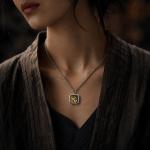
Worn at the chest, the chain should be short. Long, and the box drops — down to the stomach, where it knocks against you as you walk. Some people don't put anything sacred in it at all and use it as a small box for pills or a rolled slip of paper. The sides of a square box are straight, so it shows as an outline under clothing; it sits better under a heavier coat. Use cotton or leather cord. Nylon is slippery and the box slides along it, and once it has shifted it hangs crooked.
The tongue-and-groove is the fastest-wearing part. Open and close it often and the fitting ring thins, and once thin it loosens, and once loose it opens by itself. Don't open it often; with something inside, twice a year is enough. When the silver oxidises, the recesses on the face darken first and the raised parts brighten first, and that contrast is right. Don't soak the whole box. After washing, the fitting turns stiff, and the stiffer it is the less you dare open it, and the longer it stays shut the more it corrodes.