


Menu
By theme
By theme



{{ variable.name }} : {{ variable.values[selectedVariantsIndex[variable_index]].name }}
Quantity:
Double-sided talisman plaques are uncommon. A single-sided plaque has a plain back lying against the chest, so its orientation doesn't matter; with two inscribed faces you have to decide which one looks out. The questions people ask about these are telling. Buyers often ask which side is the front, and the maker can't answer, because both faces are full and there is no front and back, only the side against the skin and the side facing out. Some go by which way the characters read, some by the knot. Each has its own rule, and none of them is written down.
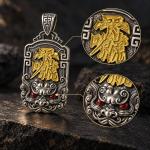
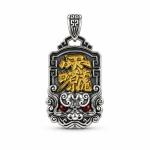
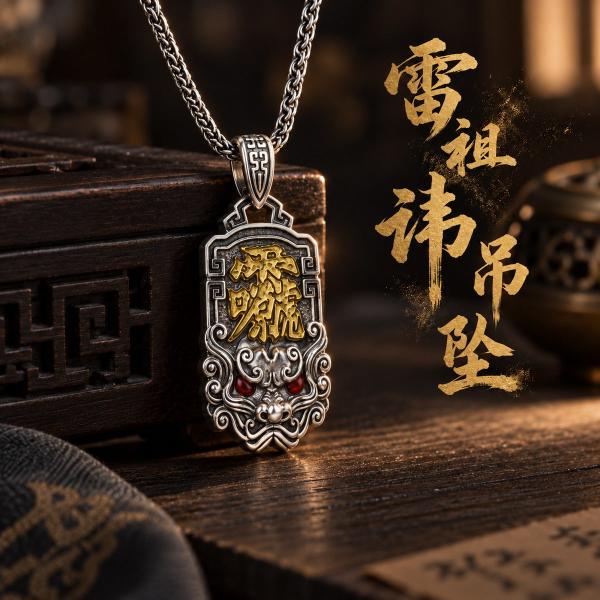
The Leizu hui is not a standard character. It is a talismanic form built by stacking, abbreviating and coiling the name. For the same deity, hui forms transmitted through different lineages differ in stroke count and even in structure, and that is not a copying error. So don't check one of these against a dictionary; failing to match is normal. The depth of the cuts and the continuity of the lines are what tell you about the work. A line that stops halfway, a stroke that never completes — that is a hand that shook while cutting.
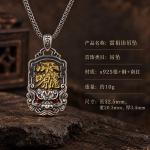
The plaque has a hole at top and bottom. The cord enters at the top and leaves at the bottom, which fixes the plaque in place. The patterns on the two faces must align, and if the casting is off by half a millimetre you can see it when you turn the piece over: lettering on the front drifting left, pattern on the back drifting right, and the whole plaque feeling twisted in the hand. That kind of error can't be corrected. It goes back into the crucible. The inside of the holes should be smooth, because a coarse cord rubbing there frays within days.
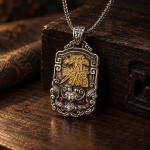
A double-sided plaque turns over easily. With a loose cord it rotates within a few steps and the other set of characters faces out. Tie the knot firmly, or add a small spacer above to hold the plaque in place. The plaque has real weight, so choose a chain that can carry it; a fine chain on a heavy plaque and the chain goes first. Worn against the body with the inscribed face inward, the characters press into the skin, and after a day there is a pattern printed on your chest that a shower removes. Use a dark cord. Pale cord absorbs sweat and yellows within days.
Once the silver darkens, the lettering actually reads more clearly, which is one of the few advantages of this kind of plaque. Don't be quick to wipe it: flatten the contrast and the characters go shallow. If you must clean, dry-brush with a soft brush to lift the loose dust. When oxidation has gone properly black, use a silver cloth on the raised face only and leave the recesses, because that black is part of the lettering. Soak the whole piece in dip and both faces come out equally white, lettering and ground merging, and all the carving is wasted. Once a season is enough, and dry it before storing.