


Menu
By theme
By theme






{{ variable.name }} : {{ variable.values[selectedVariantsIndex[variable_index]].name }}
Quantity:
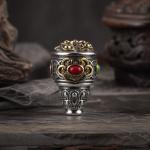
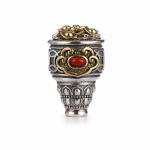
A treasure basin is an open bowl with a flared rim, heaped with ingots and coins until the pile stands above the edge. Made as a component, the bowl faces up and the holes run through the sides near the base, or straight through the rim. The diameter of the mouth decides where it goes: a large one can only be a pendant, while a small one can sit in a strand as a spacer. The ingots should sit on top of the coins, coins stacked below and ingots above; reverse the order and it looks chaotic rather than abundant.
The treasure basin story is attached to Shen Wansan, a wealthy man of the Jiangnan region at the end of the Yuan and the beginning of the Ming. Folk tradition says his household had a basin in which whatever was put would multiply, so that a single coin would grow into a basinful. That is legend. There is no such basin in the histories, and even Shen's biography is recorded vaguely. The story spread because it speaks to the wish for gain without effort, which has nothing to do with the basin itself. New Year prints of the treasure basin carry the same idea. In the common prints two boys stand on the rim, one holding an ingot and one raising a ruyi sceptre, which is a later addition.
The basin is a concave surface, and polished it gathers a pool of light inside. Polishing a concave face is harder than a flat one: the wheel can't reach the bottom, and uneven pressure leaves a ring of haze. On a good basin the light spreads from the centre and shifts as you turn the piece; on rough work the light smears and looks dull rather than deep. The flared rim must be even as well. Wide on one side and narrow on the other and the whole basin sits crooked.
Used as a spacer, it goes in the middle of the main strand with the mouth up, so that you can see the ingots inside as you walk. It also works as a small pendant on a short cord, hung from a bag. Facing up, it collects dust, which settles in the gaps between the ingots and hardens into a layer over time; brush it with a soft brush and water, then stand it upside down to dry. Swinging on a bag it knocks about, and the points of the ingots hit the zip, leaving a white mark each time.
The rim is thin and a knock will roll it over, and a rolled rim is hard to correct. Kept in a pocket with keys and coins, the rim is the first casualty. The points of the ingots are another weak spot. Struck against something hard they bend, and a bent point can be eased back with a toothpick — not pliers, which leave a jaw mark. The piece doesn't need frequent washing; wash it often and the light on the concave face scatters and stops gathering. It looks best mouth up on display; when storing, turn it over so that dust doesn't fall in.