


Menu
By theme
By theme

{{ variable.name }} : {{ variable.values[selectedVariantsIndex[variable_index]].name }}
Quantity:
The vajra was originally something held in the hand, not hung around the neck. An ancient Indian weapon that later became a Buddhist ritual implement, made in bronze and iron, prongs at both ends and a grip in the middle. The number of prongs matters: one, three, five, nine. Five is the most common, five prongs answering the five directions and the five Buddhas. By the time it reached China proper the vajra was mostly made small, strung on a bracelet where it could no longer be gripped, only its shape left. The silver versions are shorter still, because silver is soft and long prongs will not stand. Hanging is fine; strung tight, they bend.
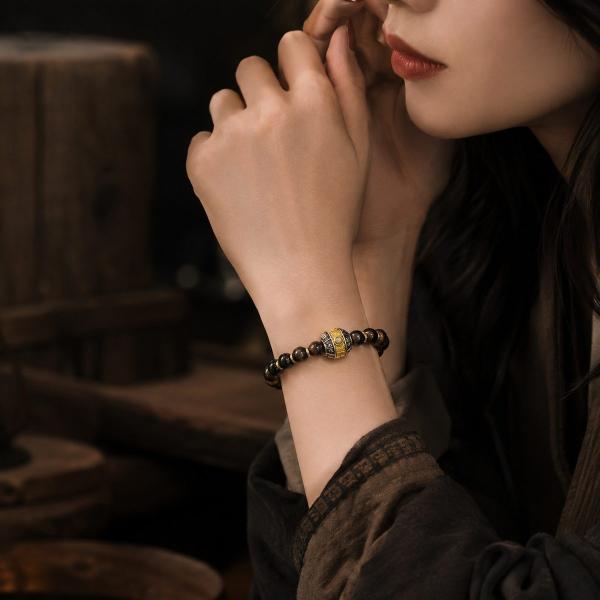
As a component, position matters more than style. On a strand of beads, set a vajra every so often and the eye pauses there, so the strand stops reading as one flat line from end to end. Stringing it lengthwise or crosswise are two different things. Lengthwise, the vajra stands upright between beads like a short pillar and the strand looks taller. Crosswise, it lies down with its ends pointing left and right, taking up more width, and on a thin wrist it turns. The rhythm of the whole strand depends on it as well. All 8 mm beads with one 10 mm vajra dropped in the middle: the eye lands on the vajra first, then scatters back to the beads. It is a common way to build a strand.
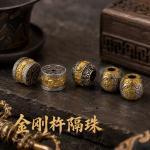
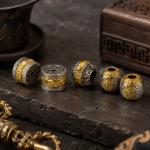
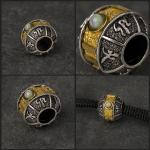
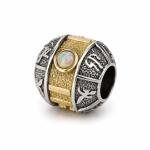
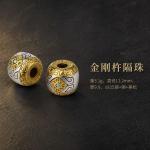
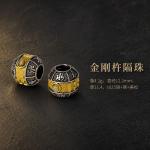
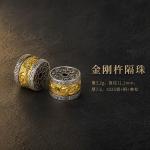
Three styles take three approaches. The vajra component is a single vajra, plainest in form, its prongs smooth with only a central ridge left. Vajra Component 2 adds pattern to the body and narrows the gaps between prongs, which uses more metal in the casting and is likelier to throw sand pits. The vajra bead turns the whole thing into bead form, the outer ring polished round so it does not dig into the wrist, which suits the center of a strand as the main bead. Bore sizes differ too. The bead has the widest hole, wide enough for doubled cord; the single vajra has the smallest, and only fine thread passes easily.
It pairs with any bead. Dark wood, bodhi seed, south red agate: the white of the silver is the note that lifts them. On an all-silver strand it blurs into one mass, and a few dark beads mixed in help. The vajra is heavier than the beads, so leave one light bead at each end when stringing and the strand will hang straight. Color need not match. Silver sits well with deep red, ink green, navy. With bright yellow or orange it fights, but that is the beads being too loud rather than the silver failing to hold them down.
Silver dislikes knocks. The prong tips are the thinnest part; drop one on tile and it bends, and bending it back leaves a mark. Lay a cloth down when you work, and do not push the piece around a tabletop hunting for the hole. For people who work with their hands, the edges will fray the cord, so change the cord every six months rather than have it snap halfway. Tarnish is normal and the recesses darken first. Two passes with a polishing cloth along the direction of the prongs, and the black stays in the crevices, which is what gives the prongs their edge.